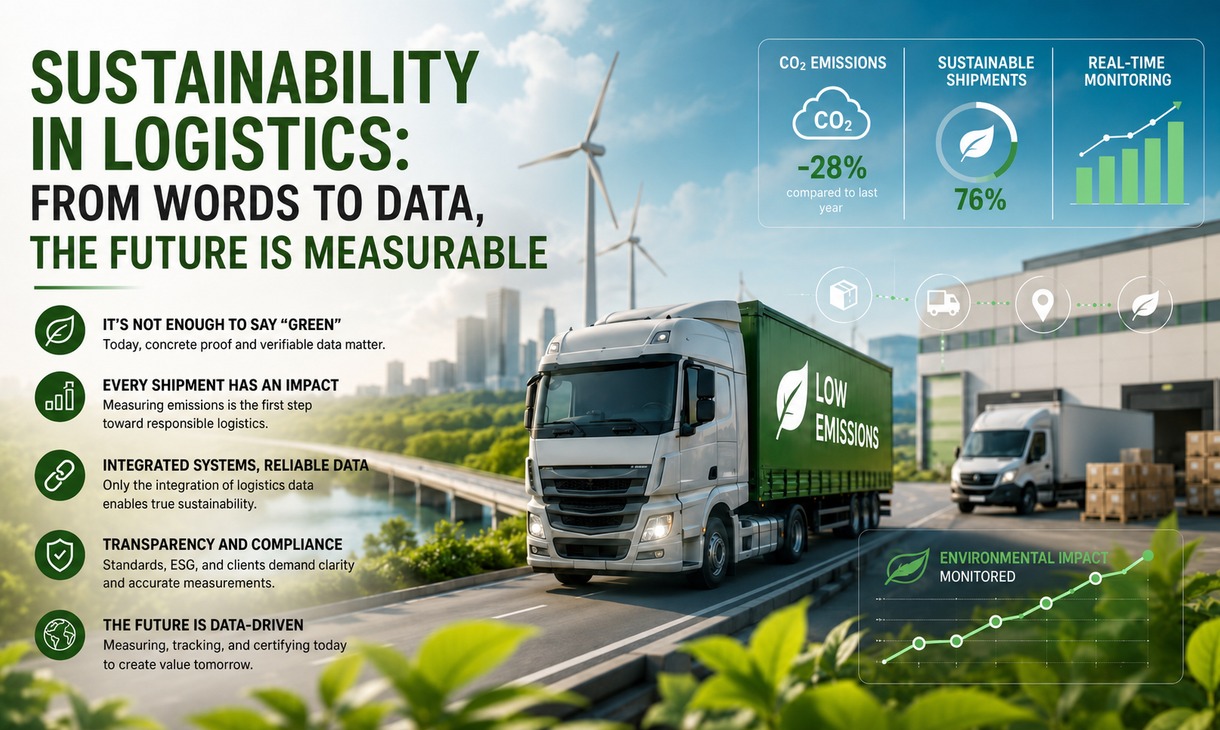
Companies talk about sustainability. Customers start asking for proof.
In recent years, sustainability has become one of the most present topics in the business world. More and more companies are talking about reducing emissions, ecological packaging, a sustainable supply chain and environmental responsibility.
But while marketing continues to fill up with words like green, eco and carbon neutral, the market is changing rapidly. Customers, partners and even regulations are starting to ask for something different: concrete evidence.
And it is precisely here that one of the most underestimated problems in the logistics sector emerges.
The invisible side of sustainability
Many companies rightly invest in renewable energy, recyclable materials or more efficient production processes. However, an important part of the environmental impact often remains poorly controlled: logistics.
Every shipment generates emissions. Each return produces additional movements. Every warehouse transfer, every urgent delivery, every fragmented transport contributes to the overall environmental impact.
The problem is that, in most cases, this data is not really monitored in a structured way.
Saying that a shipment is "green" is no longer enough
Until a few years ago it was enough to communicate attention to sustainability to obtain a competitive advantage. Today the context is different.
Companies must deal with:
- more informed customers;
- most demanding commercial partners;
- ESG processes increasingly widespread;
- new European regulations on Green Claims;
- growing attention to Scope 3 emissions.
In this scenario, generically declaring that a shipment is sustainable risks no longer being sufficient. It becomes necessary to demonstrate:
- what data was collected;
- which parameters were used;
- what real impact did an expedition have;
- which logistical processes were involved.
The real problem? Disconnected systems
The difficulty lies not only in calculating emissions. The real obstacle is obtaining reliable data.
Many companies use separate platforms to:
- eCommerce;
- marketplaces;
- ERP;
- couriers;
- warehouses;
- tracking;
- order management.
When logistics data is fragmented, it becomes extremely difficult to build a clear view of the real environmental impact.
Without integration there is no precise measurement.
And without measurement, sustainability risks remaining just communication.
From traditional logistics to measurable logistics
The digital transformation of the supply chain is also changing the way in which companies address the environmental issue.
Today, platforms designed not only to ship or manage orders, but to connect operational data, logistics flows and environmental monitoring into a single ecosystem are beginning to emerge.
It is in this context that Logivery fits in, a platform that integrates marketplaces, logistics operators, couriers and operational management with tools dedicated to the measurement and certification of logistics impact.
The objective is not simply to "declare sustainability", but to transform each shipment into a monitorable, traceable and documentable process.
The sustainability of the future will be based on data
Logistics is entering a new phase. For years the focus has been on speed and cost reduction. Today a new variable is added: transparency.
Companies that manage to integrate logistics data, automation and environmental monitoring will have an increasingly important competitive advantage, both towards the market and towards partners and investors.
Because in the near future it will no longer be enough to say that an expedition is sustainable.
We will need to be able to demonstrate it.