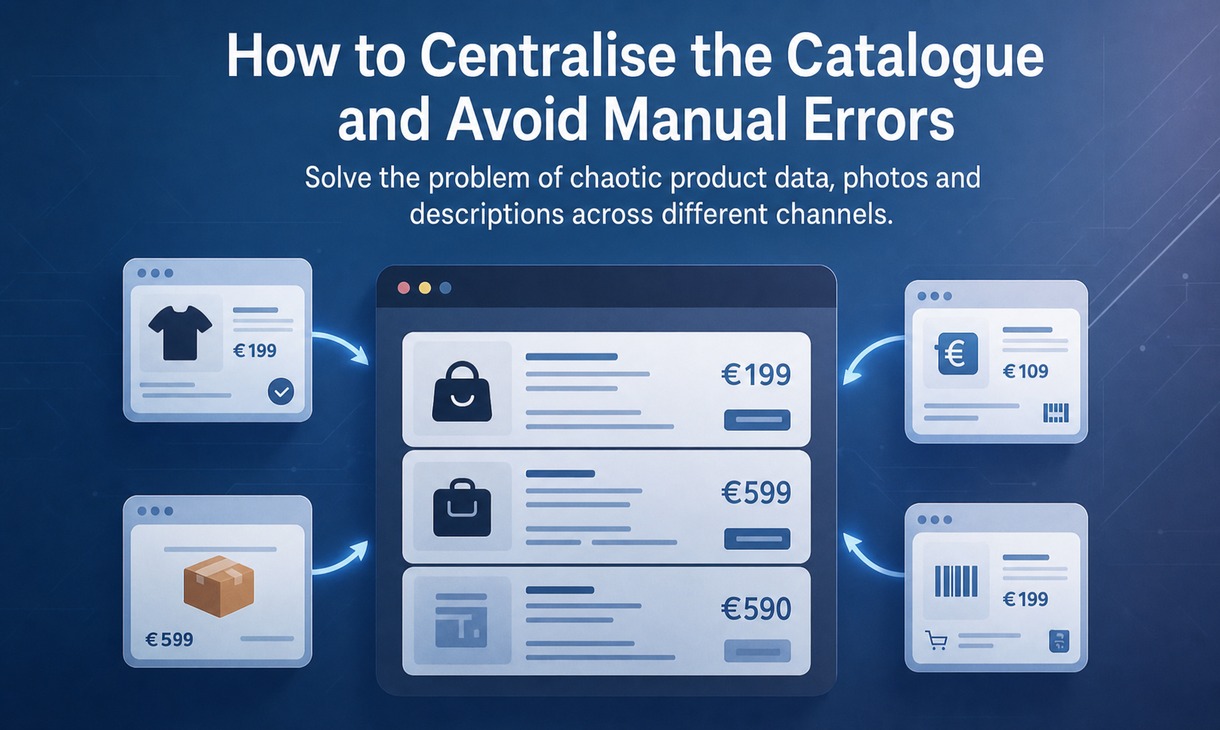
How to Centralise the Catalogue and Avoid Manual Errors in Multichannel Sales
When an eCommerce starts selling on multiple channels — marketplaces, comparisons, social commerce, international sites — catalog management quickly becomes one of the most complex and critical aspects.
It is not only about quantity of products, but of data structure, consistency of information and ability to adapt the catalogue to platforms with very different rules.
In depth: CMS e-commerce for complex catalogs: how to manage thousands of products and variants
The problem of “distributed” management of the catalogue
Without a centralized system, each update becomes a repetitive and risky operation:
- an updated image on the site but not on Amazon
- a correct title on eBay but different on other marketplaces
- A SKU updated in the management but not in sales channels
- correct measurement on a feed but wrong elsewhere
To this are added:
- categories not aligned
- inconsistent descriptions
- missing attributes
- ads rejected by marketplaces
Daily work is transformed into:
- continuous copying
- manual uploads of images
- parallel Excel file management
- repeated corrections of the same errors
With the increase of channels, complexity grows exponentially.
Why multichannel without non-scale centralization
Managing the catalogue “a silos” can work in very simple contexts.
But it is not sustainable when:
- the catalogue grows
- channels increase
- languages become more than one
- enter into play vertical or international marketplaces
In these scenarios, each new channel not only brings opportunities, but also new error surfaces.
The concept of Master Catalog
Effective multichannel management is based on a key principle:
a single main catalogue (Master Catalog) on which all channels depend.
A Master Catalog allows:
- maintain a single product
- centralize images, descriptions and specifications
- apply rules and automatic transformations
- generate different versions of the product card for each channel
- update all channels starting from one point
This approach drastically reduces errors and duplications, making the catalog governable and scalable.
Strategic vision: Beyond the website: why an omnichannel strategy is crucial in 2026
Centralized catalog 😉 identical catalog everywhere
Centralizing does not mean publishing the same product card on each channel.
Each platform has different needs:
- some marketplaces require detailed technical attributes
- others prefer short and commercial titles
- Comparators depend on structured feeds
- social commerce require more synthetic content
A centralized catalog system must therefore allow:
- starting from a unique base
- adapt content, titles and attributes based on the channel
- maintain consistency without rigidity
The role of rules and transformations
In mature projects, the Master Catalog is not only a database, but a “intelligent” system that allows:
- map different categories from a unique structure
- transform attributes based on channel requirements
- generate different titles and descriptions
- manage variants consistently
- support multilingual and multi-currency
This level of automation allows multiply the channels without multiplying the work.
Integration as an enabling factor
To really work, the centralized catalog must dialogue with:
- eCommerce owners
- general marketplaces
- vertical marketplaces
- price comparisons
- management and logistics systems
The alignment of product data must proceed together with the proper management of orders, availability, warehouses and shipments. To deepen these processes, consult our complete guide to logistics management eCommerce.
When availability needs to be updated on multiple channels, it is essential to avoid delays and unfairness. To deepen this aspect, consult the guide on how to sync the stock between eCommerce and marketplaces and avoid overselling .
For this reason, many companies adopt a layer of integration, which deals with orchestrating the distribution of the catalogue to the different channels.
Technical study: Integration platform for complex eCommerce
The concrete benefits of centralization
A centralized catalog allows:
- drastically reduce manual errors
- accelerate product publication
- keep all channels aligned
- avoid rejected ads
- improve the overall quality of product cards
- strengthen the coherence of the brand
- work sustainably with many channels
In the medium term, radically changes the way of working the team.
Conclusion
The multichannel is not a matter of How many channels are used, but of as they are managed.
Without a Master Catalog:
- each new channel adds complexity
With a Master Catalog:
- every new channel becomes an opportunity
Centralizing the catalog is therefore one of the fundamental pillars to build a solid, efficient and truly scalable multichannel eCommerce strategy.
For a complete view of channels, catalog, stock, prices, orders and logistics, consult our guide to the multichannel sale.