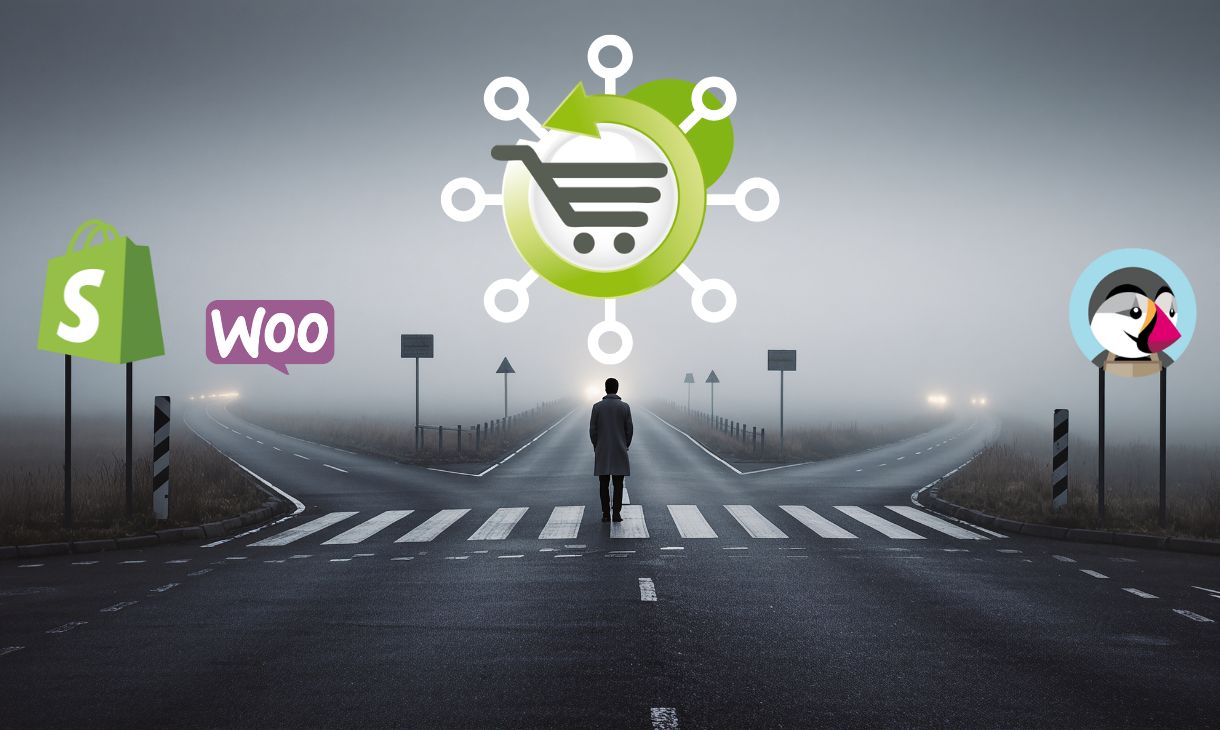
Shopify, PrestaShop or WooCommerce? Why integration is more important than the platform
When a company decides to start or renew its online presence, the first question that blocks any strategic meeting is almost always the same: "What platform do we choose? ".
Hence the eternal debate between:
- Shopify, appreciated for simplicity and speed of start
- WooCommerce, the most widespread open-source solution, integrated with WordPress
- PrestaShop, very solid and widespread open-source platform in Europe
Compare features, costs, graphic themes and app marketplaces.
In depth: How to choose the right CMS for an e-commerce project with complex catalogs
But this, however important, is not the decision that determines operating success in the medium-long period.
The platform is the showcase, not the engine
Shopify, PrestaShop and WooCommerce all play the role of front-end sale.
But the real engine of the eCommerce business is a step further back, and it consists of:
- the management (ERP)
- the warehouse
- the logistics
- the marketplaces
- data flows between these systems
When orders, warehouses, availability and shipments must be coordinated between multiple systems, logistics becomes an integral part of eCommerce’s digital architecture. We have deepened these aspects in our guide to logistics management eCommerce.
The eCommerce platform is only one of the nodes of ecosistema, not the center.
The difference between a simple presence on multiple channels and a truly integrated experience is in-depth in our comparison between multichannel and omnichannel sale .
In depth: How to centralize the catalogue to avoid manual errors in the multichannel
The real problem: sync data
In a very common scenario, a company:
- sells on your site eCommerce
- opens one or more marketplaces (Amazon, eBay, etc.)
- manages invoicing and warehouse on a management
Without adequate architecture, the team finds itself:
- load the product cards several times
- manually update the stocks
- download orders from different channels
- reinserting data in management
This is where one of the most critical problems of the multichannel arises: the overselling.
The false solution: the “ragnatela” of plugins
Each platform proposes its own answer:
- WooCommerce and PrestaShop → modules
- Shopify → app
The risk, however, is always the same: to create a network of point-to-point integrations.
The typical result:
- a plugin for Amazon
- one for eBay UK
- one for the management
- one for the logistics
Each update becomes a risk of incompatibility, and technical maintenance grows silently but constant.
The strategic approach: the “hub” model
Successfully scaled companies adopt a different approach:
not a web, but a hub-and-spoke model.
In this scheme:
- the management remains the source of truth
- the eCommerce platform becomes a channel
- marketplaces become channels
- a central layer coordinates everything
This model is particularly useful when the company adopts a strategy of multichannel sale, because it allows to coordinate catalog, prices, availability and orders without managing each channel as a separate system.
This integration layer has the task of:
- dialogue with the ERP
- distribute consistent data to channels
- collect and normalize orders
Technical study: Integration platform for complex eCommerce
Why integration is more important than the platform
With a well designed integration architecture:
- the platform becomes replaceable
- data remains centralized
- flows should not be rebuilt from zero
That means:
- migrating from PrestaShop to Shopify (or vice versa) is much less traumatic
- add a marketplaces does not create chaos
- the company maintains operational control
Strategic vision: Beyond the website: why an omnichannel strategy is crucial in 2026
The concrete benefits of an integrated ecosystem
An integration-based approach brings immediate benefits:
- Reliability: stock aligned, stop to overselling
- Operational efficiency: less data-entry, more strategy
- Scalability: new channels without multiplying work
- Technology freedom: no lock-in on the platform
The choice of the platform remains important, but Stop being the bottleneck.
Conclusion: the right question to ask
Amazon, eBay, Shopify, PrestaShop, WooCommerce, Logistica, ERP