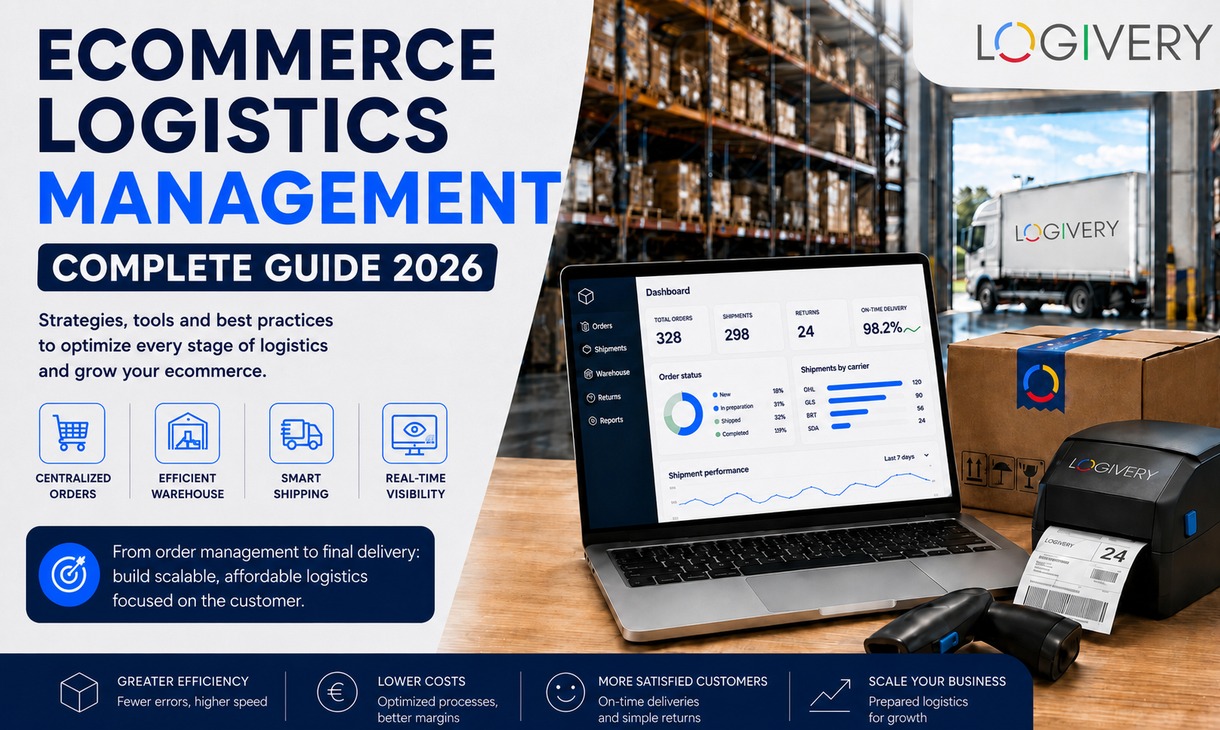
eCommerce Logistics Management: Complete Guide 2026
Logistics is where most ecommerce brands stop growing.
Not because the product is wrong. Not because there is a lack of orders. But because the operational structure that worked with 50 orders a day starts to creak at 200, and collapses at 500. And when logistics collapses, the problem becomes immediately visible to the customer - late delivery, wrong package, made impossible - with damage to reputation that no marketing campaign can quickly repair.
This guide is for operations teams and founders of ecommerce brands who want to understand how efficient logistics management works, what tools exist, and how to choose the right approach based on their growth stage.
eCommerce logistics covers every physical and digital operation that takes place between the moment a customer clicks "buy" and the moment they receive the package — and, increasingly, also includes the moment they return it.
In traditional retail, logistics worked on predictable volumes, with orders in pallets to fixed points of sale. In the ecommerce world, each order is a single unit with a different address, increasingly shorter expected delivery times, and real-time tracking expectations that were previously the exclusive preserve of large operators.
The main operational differences that each eCommerce brand must handle

Fragmentation of sales channels
A brand that sells on its own site, Amazon, a vertical marketplace and in wholesale ha four separate order flows that they must flow into a single fulfillment system, without the inventory being desecrated.

Variability of volumes
The peak of Black Friday can bring 10 times the volume of a normal day. The logistic structure must absorb it without errors and without exponential costs.

Delivery speed as competitive standard
The Amazon effect shifted expectations: the customer considers delivery in 24-48 hours as a baseline, not as a premium service.

Complexity of returns
In fashion and some vertical, the return rate exceeds 30%. Each return is an inverse order that must be received, inspected, reintegrated to stock or disposed of — with full visibility for the customer.
The four pillars of logistics eCommerce
Efficient eCommerce logistics management is based on four components that need to work in an integrated way.

Order Management (WHO)
The Order Management System is the system that receives orders from all sales channels — proprietary site, marketplace, physical stores — and consolidates them in a single processing queue. An effective WHO:
- Automatically capture each order within seconds of its creation
- Attributes to each order the source of origin and management priorities
- Send order to the correct warehouse (or 3PL) with all necessary data
- Update the sales channel on fulfillment progress
Without a WHO, the operating team works on Excel sheets, emails and multiple dashboards, increasing the risk of errors, delays and manual relays in order management.

Warehouse Management (WMS)
The Warehouse Management System governs everything that happens within the warehouse: reception of goods, storage, picking, packing, labelling and shipping. Key features of a WMS for ecommerce include:
- Receivement and putaway: automatic registration of the incoming warehouse and optimal allocation of the lease
- Optimized picking: calculated picking paths to reduce time and errors
- cyclical inventory count: continuous detection of stock discrepancies without blocking operations
- Handling support: integration with scanner, pick-to-light, automation
A modern WMS for eCommerce SMB does not require investment in hardware infrastructure: current cloud solutions are activated in weeks and scale according to volumes.

Courier Management (TMS)
The Transportation Management System manages the relationship with couriers: selection of the optimal carrier for each shipment, automatic generation of labels, tracking and communication to the customer. For a brand that sends with more than one courier — and almost all should do so, to reduce dependence on a single operator — a TMS becomes indispensable. Without it, the team must manually access the portals of each courier, with duplication of work and impossibility to make automatic shopping installments.
The features that make the difference in a TMS for eCommerce:
- Automatic shopping rate: real-time comparison between the rates of couriers available for each shipment, selecting the optimal combination of cost, speed and reliability of the carrier
- Label generation in bulk: automatic label production without manual intervention
- Unified Tracking: One interface to monitor all shipments, regardless of courier
- Proactive notifications to the customer: automatic updates on delivery status

Visibility of inventory in real time
The fourth pillar is not a single system but a capacity: to know at all times how many units of each SKU are available, where they are, and if they are allocated to orders already in work.
This visibility is the basis for everything else. Without it, phenomena such asGhost inventory (the system says a product is available but physically not there), overselling (purchase of sold products), and the purchase of supplies already present in stock.
The most common problem: eCommerce runs on Shopify, the warehouse on a legacy management or Excel sheets, the courier on a separate portal, and the commercial department works with an ERP that does not talk to any of the three. Each handoff between systems introduces delays, manual errors and loss of information.
The direct consequence is an operational latency which results in late-worked orders, stockouts not detected in time, and impossibility to give the customer accurate information about their order.
Ghost Inventory

Dependence on a single courier
Resis not managed as part of the product

Logistic in-house or 3PL: how to choose
One of the most important decisions for a growing ecommerce brand is whether to manage logistics internally or entrust it to a third party operator (3PL — Third Party Logistics).
There is no universal answer, but there are clear criteria for making the right decision.

Logistics in-house
it is when:
- The brand has very specific packaging customization needs
- Quality control on the product before shipment is critical
- The margins allow to support the fixed costs of space and staff
- The volume is high enough to cushion the investment in structure

The 3PL
it is when:
- The volume is still variable and the fixed costs would be unsustainable
- The brand wants to expand geographically without multiplying structures
- Internal logistics skills are limited
- You want to access advanced WMS/TMS technologies without investing in development
The third way, always more traveled, is that of a hybrid system: a cloud logistics management software that connects the internal warehouse (or more warehouses, including 3PLs) with all sales channels and all couriers, giving visibility and control regardless of where the fulfillment takes place.
How to evaluate an eCommerce logistics management platform
If you are considering the adoption of a logistic software, these are the criteria that really make the difference in the selection stage, much more than the length of the feature list.

Integration depth, not number.
A system with 50 "superficial" integrations is worth less than one with 10 deep, tested and maintained integrations. Check that theintegration between eCommerce platform and operating systems both native and bidirectional, not limited to a simple scheduled import/export.

Visibility of inventory in real time.
Does the system update the stock available on all channels within how many seconds from a physical movement? A delay in hours is unacceptable.

Flexibility on the courier park.
Can you add a new courier independently? Is shopping rate automatic or requires manual configurations every time?

Scalability of pricing.
Attention to pricing models that penalize growth: fees that grow exponentially with volumes, fees for each additional integration, hidden costs for features that seemed included.

Support for onboarding and training.
The warehouse staff must be able to use the system effectively. Evaluate average training time and support quality during the first months.
Logivery: the operational platform for ecommerce logistics.

Gestiamo

Orders from all channels
Shopify, WooCommerce, marketplace, EDI wholesale — in a single fulfillment queue

Magazzini
real-time inventory visibility, WMS Lite for reception and putaway management, automatic allocation of optimal warehouse for each order

Corrieri
7+ active integrations, automatic shopping rate, label generation in bulk, unified tracking

Marketplace logistics
purchase of space, transport and equipment services directly on the platform

Sustainability
Green Label certified with CO2 calculation equivalent for shipment and compensation with verified carbon credit

AI
Logivery's AI-powered approach means that the platform is not limited to performing operations: it analyzes historical data to map the logistic footprint of each customer, simulates strategies on KPI cost, speed and emissions, and automate configurations that today require manual intervention.