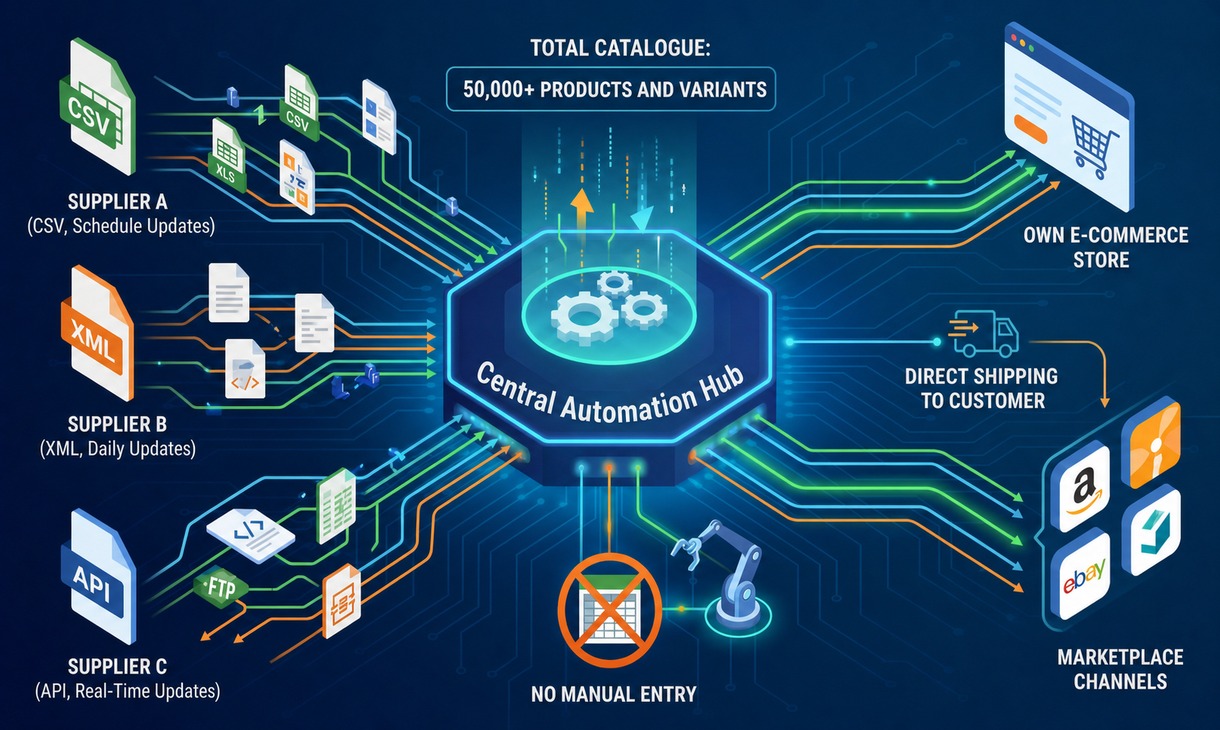
Automated dropshipping: how to import supplier catalogs and synchronize them with sales channels
Modern dropshipping is no longer based on manual uploads or Excel files updated "as it happens".
In structured projects - both B2C and B2B - dropshipping only works if managed as a continuous data integration process.
Let's see how an automated dropshipping model actually happens, starting from a real and typical case.
Manage everything manually is not an option.
Step 1
Importing Supplier Catalogs (CSV, XML, API)
Each supplier provides its catalogue through:
- CSV file (FTP or URL)
- XML feed
- endpoint API
- scheduled updates (days / hours)
The integration platform:
- download feed automatically
- version of the data
- intercept changes (new products, updates, deletions)
Key point: the supplier catalog is NOT published directly.
Step 2
Field mapping (supplier → master catalogue)
Supplier raw data mapping towards a Master catalogue.
Example:
| Dato fornitore | Campo master |
product_name | |
sku_supplier | |
qty_available | |
price_wholesale | |
Step 3
Catalogue enrichment
Once normalized, the products come enriched:
- optimized eCommerce and marketplace titles
- more complete descriptions
- standardized images
- missing technical attributes
- exclusion rules (non-sales products)
This passage is crucial: the value is not import, but make it sellable.
Step 4
Rules of pricing and availability
Automatic rules are applied on the master catalogue:
- different embroidery for supplier
- different embroidery per channel
- rounding
- minimum stock thresholds
- block sale if stock < X
Example:
If the supplier has less than 3 pieces → product not sold on marketplaces
This avoids:
- overselling
- problematic orders
- negative reviews
Step 5
Distribution on sales channels
Only at this point the catalogue is distributed on:
- eCommerce owner
- general marketplaces
- vertical marketplaces
- B2B channels
Each channel receives:
- the correct format
- the correct categories
- dedicated titles and descriptions
- specific prices
Everything from the same master catalogue, without duplication.
Step 6
Continuous stock synchronization
Supplier feeds are updated at regular intervals (even every hour).
The platform:
- intercept stock variations
- update availability on the master catalogue
- propagates the change to all channels
This is the heart of automated dropshipping.
Without this passage:
- the model is not reliable
- the reputational risk is very high
Step 7
Automatic Order Management
When an order arrives:
- the order is collected from the channel
- the system identifies the correct provider
- the order is automatically sent to the supplier
- the supplier sends
- tracking and status fall into the system
- the customer receives consistent updates
The merchant does not intervene manually, even with:
- more suppliers
- more channels
- more models (stock + dropshipping)
The result: industrialized dropshipping
A model of this type allows:
- manage dozens of suppliers
- climbing the catalog without chaos
- sell B2C and B2B
- reduce operational errors
- maintain reliability to the customer
The dropshipping stops being a shortcut and becomes a strategic lever.
Conclusion
The dropshipping that works in 2025 is not the improvised one, but the designed one.
Importing catalogues, normalizing data, synchronizing stocks and automating orders are not technical details, but foundations of the business model.
Those who invest in integration can sell:
- more
- on multiple channels
- with multiple suppliers
- without losing control
The real advantage is not selling without a warehouse, but selling without chaos.