TikTok Shop, Temu, Amazon and eBay: which channel to choose to sell online?
Selling online today no longer means simply choosing between "having an eCommerce site" or "selling on Amazon". The panorama has expanded: traditional marketplaces, promotional platforms, social commerce, vertical channels and hybrid models offer very different opportunities.
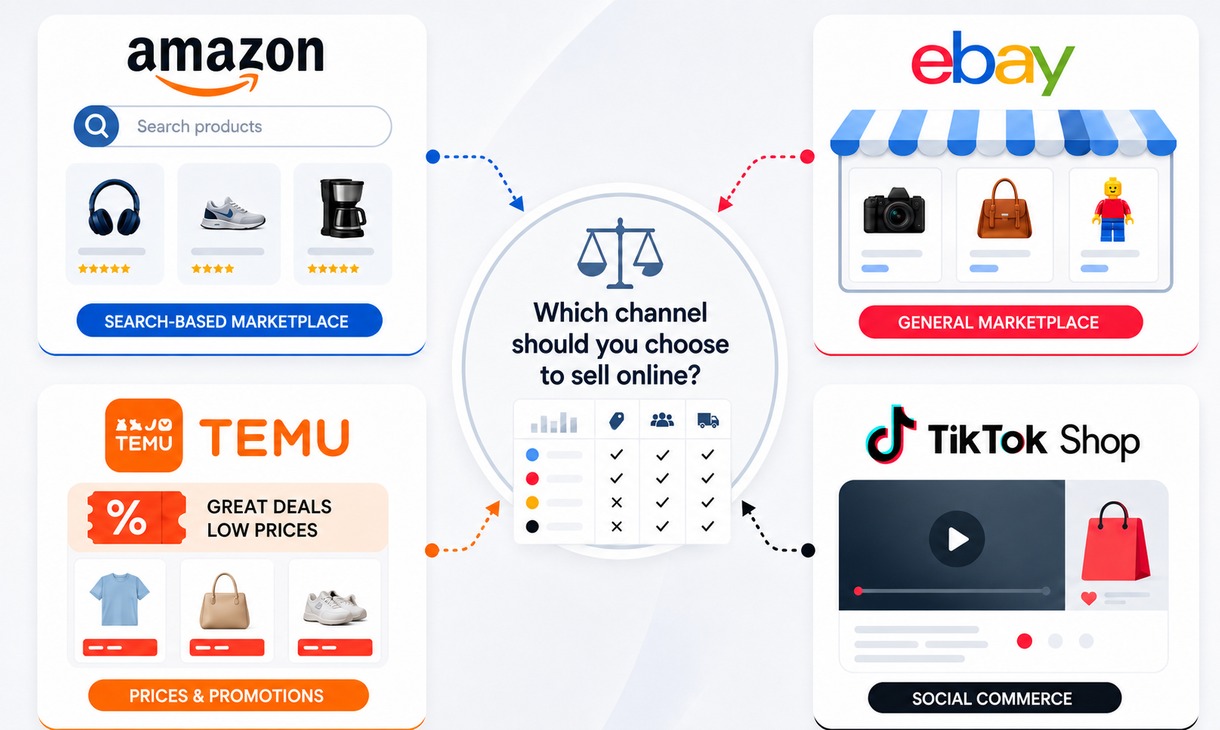
Amazon, eBay, Temu and TikTok Shop are four very interesting examples because they represent different logics of online sales.
Amazon intercepts an existing question
eBay offers amplitude, variety and verticality
Temu bets on price, volume and strong promotional ability
TikTok Shop introduces a logic closer to social commerce, where content, creator and purchase become part of the same path
The question therefore is NOT
What is the best channel? →
The most correct question is:
what is the most suitable channel for your product, its margin and its operational capacity?
Amazon: the already existing demand marketplace
Amazon is often the first marketplace that companies and sellers think about when they want to expand online sales.
Its main force is the question already present on the platform. Many users enter Amazon with a clear purchase intention: they look for a product, compare prices and reviews, evaluate delivery times and proceed to order.
This is why Amazon is particularly interesting for products already known, comparable and sought after by users.
Who sells on Amazon can benefit from a very structured ecosystem, with product publishing tools, inventory management, logistics, advertising and sales in multiple European marketplaces through a single account. Amazon itself presents the possibility to reach customers in different European stores and manage advertisements and inventory centrally.
The strength is evident: access to a huge audience and already oriented to purchase.
At the same time, however, competition is high. Sellers must confront other operators, with aggressive price policies, with commissions, advertising costs and increasingly precise operational requirements.
Amazon can be a very effective channel, but it requires attention to margins, logistics, reviews, product content and competitiveness management.
eBay: amplitude, variety and vertical categories
eBay has a different story than Amazon. Born as a platform very tied to auctions and sale among private individuals, over time it has evolved also as a marketplace for professional companies and sellers.
Today eBay remains interesting for many commodity categories, especially when the product has a specific research component, limited availability, spare parts, collectors, used, regenerated, accessories or technical spare parts.
Compared to Amazon, eBay can be less standardized and more flexible in some categories. The platform can be useful for sellers who have large catalogs, special products, articles not always easily comparable or merceologies where the variety is a strength.
The value of eBay is therefore in its breadth and capacity to serve niches of demand.
For some companies it may not be the main channel, but it can become a very useful complementary channel, especially if properly integrated into the multichannel strategy.
The main criticism is that the purchasing experience can be less uniform compared to other more standardized marketplaces. Also on eBay are important reputation of the seller, quality of the listings, price, availability and punctual management of orders.
Temu: price, volume and strong promotional push
Temu is still a different logic.
Its positioning is strongly oriented to price, promotion, scope and volume. For consumers, Temu is often perceived as a platform to find products at very competitive prices, with a strong promotional component and a navigation oriented to the discovery of offers.
For sellers, this can mean access to a channel with Great potential visibility, but also strong pressure on prices and margins.
Temu opened the marketplace also in sellers with European entities, including countries such as Italy, Germany, France, Spain, the United Kingdom and the Netherlands according to different industry sources.
The platform can be interesting for companies that have products suitable for volume logic, competitive prices, wide availability and ability to operate a flow of potentially high orders.
But it is not a channel suitable for everyone. Those who work with small margins, premium products, very controlled brand positioning or complex combinations must carefully assess whether Temu is consistent with its strategy.
In addition, the European regulatory framework on large marketplaces is increasingly attentive to product safety, compliance and consumer protection. This is also an element to consider when evaluating a strategy on high growth platforms and strong competitive pressure.
TikTok Shop: content, discovery and creator
TikTok Shop introduces a different logic compared to traditional marketplaces.
Here the purchase does not necessarily arise from a research. It can be born from a video, from a live review, from a creator or content that intercepts the user while surfing the platform.
TikTok Shop allows brands and creators to show and sell products directly on TikTok through integrated touchpoints such as affordable video, LIVE shopping, shop page and in-app catalog.
This is the big difference from Amazon or eBay.
On Amazon, the user often searches for a product.
On TikTok Shop the user can discover a product.
For this reason TikTok Shop can be particularly interesting for visual products, demonstrative, recountable or related to trends and communities.
Some potentially suitable categories are:
- beauty;
- fashion;
- accessories;
- products for the house;
- gadgets;
- packaged food;
- lifestyle products;
- animal articles;
- simple consumer electronics to show.
The strength is the ability to merge content and conversion. A product can be seen, explained, desired and purchased in a very short route.
The criticality is that TikTok Shop requires a different mentality. You don't just need to upload a catalogue: you need content, creator, order management, and attention to availability.
Effective content can generate sudden peaks of demand. This can be an advantage, but only if the company is ready to manage stocks, logistics, shipments, returns and customer support.
Traditional Marketplace or social commerce?
The difference between traditional marketplace and social commerce is fundamental.
In traditional marketplaces, the user often starts from a defined need. Find a product, compare alternatives and choose.
In social commerce, instead, need can be born from content. The user was not necessarily looking for that product, but discovers it through a video, live or the advice of a person following it.
This also changes how companies have to submit products.
On Amazon count
- product description
- price
- reviews reviews reviews
- availability and delivery times
On eBay count
- product description
- price
- reviews reviews reviews
- availability and delivery times
On Temu count
- price
- attractiveness of the offer
- volume
- competitiveness
On TikTok count
- content
- immediacy
- creator
- product demonstration and ability to turn attention into purchase
| Channel |
Predominant logic |
Point of force |
Criticism |
| Amazon |
Existing question |
Large public and strong intention to purchase |
High competitiveness, costs and pressure on margins |
| eBay UK |
Range and verticality |
Wide catalogues, niches, special products |
Less uniform experience and strong reputation importance |
| Temu |
Price and volume |
Visibility, promotion and competitiveness on price |
Reduced margins and strong commercial pressure |
| TikTok Shop |
Content, discovery and creator |
Virility, social commerce and purchase within the app |
Need for continuous content and ready operation |
Which channel to choose?
There is no valid answer for everyone.
A company with very sought after products and competitive can find in Amazon a natural channel.
A seller with Wide catalogues, special products, spare parts or niche items may assess eBay UK as an interesting channel.
A company with products suitable for aggressive price, high rotation and volume can look at Temu, carefully assessing marginality and positioning.
A brand with visual products, demonstrable and suitable for content can be considered TikTok Shop as an opportunity for social commerce.
In many cases, the best choice is not to bet on a single channel, but build a coherent multichannel strategy.
The point is to avoid opening channels without a logic. Each platform requires adequate content, prices, logistics, assistance and operational management.
Conclusione
Amazon, eBay, Temu and TikTok Shop are not just four equivalent alternatives.
They are four different models of online sales.
Amazon works a lot on the existing question.
eBay values amplitude, variety and verticality.
Temu bets on price, volume and promotion.
TikTok Shop brings eCommerce into the world of content, discovery and creators.
The choice of the channel depends on product, marginality, publicity, operational capacity and growth strategy.
Before deciding where to sell, a company should ask not only where it can gain visibility, but also where it can compete sustainably.