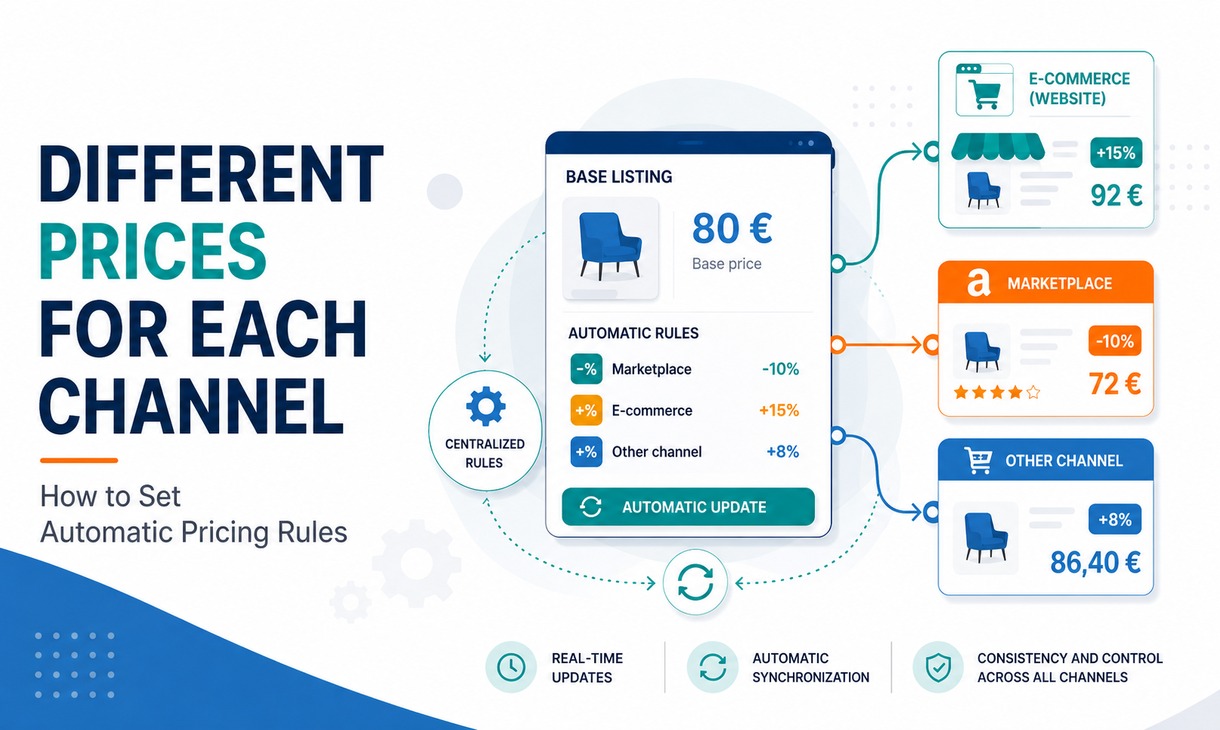
How to set different pricing rules for each channel, automatically
Selling the same product on multiple channels does not necessarily mean offering it at the same price everywhere. An e-commerce site, Amazon, eBay and other marketplaces can have very different costs, commissions and commercial strategies. For this reason, applying a single price to all channels can reduce margins or prevent you from taking advantage of specific promotions and opportunities.
An effective multi-channel strategy should instead allow you to start from a central price and automatically adapt it to the characteristics of each channel.
Integration, in fact, does not mean uniformity. It means being able to manage data, price lists and updates from a single point, while maintaining different price policies.
Because the same price is not always the best choice
Each sales channel has its own cost structure. On a marketplace can be expected:
percentage commissions on sales;
fixed quotas for each order;
logistics costs;
advertising costs;
costs for additional services;
different conditions according to the commodity category;
specific commissions for the country of sale.
The proprietary e-commerce site, on the other hand, can have more content brokerage costs and offer more freedom in managing discounts, promotions and loyalty programs. Using the same price on all channels can therefore produce very different results in terms of marginality.
A product sold at 100 euros on its site, for example, could guarantee an adequate margin. The same product proposed to 100 euros on Amazon could be less convenient after subtracting commissions, advertising costs and any logistic services.
The solution does not necessarily consist in increasing the original price in management. A change of this type, in fact, could be transferred indistinctly to all channels. It is more effective to maintain a reference price and apply a specific rule to the list intended for Amazon or another marketplace.
Integration does not mean all equal prices
One of the most common misunderstandings in multichannel sales is to think that centralization compels merchant to publish the same price anywhere. In fact, centralization is mainly about the management of information and rules. The price present in management, ERP or e-commerce platform can represent the reference value. From this data, the system can automatically calculate the price to be published on the different channels.
It can therefore be expected:
a price on the e-commerce website;
an increase on Amazon;
a different price on eBay;
a promotion reserved to the site;
a specific list for a given country;
a rule dedicated to some product categories.
The database remains centralized, but the final price changes depending on the channel. →
This approach allows you to maintain:
a single control point;
greater coherence in management;
more commercial flexibility;
a better protection of margins;
less manual interventions;
faster updates.
How price rules per channel work
Automated price management generally starts with a reference value. This data may come from:
a management
an ERP
the eCommerce website catalogue
a PIM system
a main list
a central database
From the basic price you can create different lists, each associated with a specific sales channel. Each list can apply a certain rule before the price is published. The rules may include, for example:
a percentage increase
a fixed amount increase
a percentage reduction
a discount
a rounding of the final price
the use of a dedicated list
different conditions according to the marketplace
specific rules for products or categories
Once the rule is configured, the calculation is executed automatically during synchronization. When the source price changes, the system recalculates the prices for the different channels without requiring manual modification of the individual listings.
Increase prices on Amazon to cover fees
One of the most frequent uses of price rules is for sale on Amazon. Suppose a product has a basic price of 100 euros on the e-commerce site. The merchant could decide to apply a 12% increase on Amazon to help cover fees and other costs related to the marketplace.
The rule would be: Amazon price = base price + 12% The price published on Amazon would then become 112 euros, while on the site it would continue to be 100 euros. If the basic price is up to EUR 110, the Amazon price will be automatically recalculated: 110 euro + 12% = 123,20 euro
The merchant modifies the given once, while the system updates the different channels by applying the rules already defined. The percentage must of course be established considering:
commission of the marketplace;
commodity category;
logistics costs;
advertising costs;
desired margin;
product positioning;
competition;
commercial policies of the channel.
A uniform increase can be sufficient in some cases, but it is not necessarily suitable for all products. Articles with very different margins, weights or logistical costs may require separate rules or lists.
Create promotions only available on your site
Price rules are not only used to compensate for marketplace fees. They can also be used to create specific promotions on the owner site. A company could, for example, want to encourage direct purchases, where the relationship with the customer is more immediate and the brokerage costs are generally lower. In this case you can keep the standard price on the marketplaces and apply a discount only to the site list. A product could then be published:
100 euros on Amazon
100 euros on eBay
90 euros on the site during a promotion
The promotion can be managed without intervention on the offers already present in the other channels. This strategy can be useful for:
This strategy can be useful for:
increase direct traffic on the site;
support an advertising campaign;
propose offers reserved to members;
encourage repurchase;
dispose of certain stocks;
create independent campaigns from marketplaces;
reward customers who buy without intermediaries.
After the promotion, the price of the site can return to the standard value without changing the prices of other channels.
Different rules for marketplace, country or business strategy
The price differentiation is not just Amazon. A merchant may need to use different rules based on numerous factors.
1. Costs of the marketplace
Each platform can provide different commissions, fixed shares and optional services. The same increase is therefore not necessarily suitable for all channels.
2. Country of sale
The international sale can involve different logistic, tax and commercial costs. They can also change:
currency;
competition;
purchasing power;
shipping costs;
commissions;
promotional strategies;
average market prices.
3. Product positioning
The same article can be proposed with different strategies according to the public and the channel. A marketplace can be used to achieve greater visibility, while the owner site can be oriented to loyalty and direct relationship with the customer.
4. Specific Promotions
A discount can be reserved: to the site; a single marketplace; to a certain country; to a campaign; a group of products; to a specific period of the year.
5. Margin desired
The price rule can be used to protect the minimum margin on channels that involve higher costs.
6. Disposal of stocks
A promotional price can only be applied to the channel on which you want to accelerate the sale of certain items.
The advantages of centralized list management
Manage different prices manually on multiple platforms can quickly become complex. Each variation must be replicated on different accounts, increasing the risk of errors, delays and inconsistencies. The list rules allow instead to automate the process.
Reduction of manual activities
The price is changed in the system of origin and then recalculated for each channel. You do not need to manually intervene on all ads.
Increased protection of margins
Increases can take into account the specific costs of the marketplaces and platforms used.
Faster updates
The variations are distributed through synchronizations, without having to update each channel individually.
More flexible business strategies
Each channel can have its own positioning, its own list and promotional policy.
Less risk of error
Using predefined rules reduces the possibility of publishing incorrect prices or forgetting updates.
Central control
Even when the final prices are different, the calculation logic remains managed by a single environment.
An example of multichannel strategy
A company sells a product with a basic price of 80 euros.
The commercial strategy includes:
standard price of 80 euro on the site;
10% promotional discount on the site during a campaign;
15% increase on Amazon;
8% increase on another marketplace.
During promotion, prices become:
e-commerce site: 72 euro;
Amazon: 92 euro;
other marketplace: 86,40 euros.
The merchant maintains a single reference price, but uses different rules to automatically adapt it to different channels. After the promotion on the site, the price can go back to 80 euros without changing the lists for marketplaces.
What solution can merchant adopt
To apply this strategy it is necessary to use an integration system that does not limit itself to transfer prices from one platform to another, but allows to define specific rules and lists for each channel. Among the solutions that allow to manage this type of process, dirCommerce reports bindCommerce, Italian platform dedicated to the management and integration of multichannel sales. Through the list rules available in bindCommerce, the merchant can start from a centralized price and establish how this value must be transformed before publication on the different linked channels. It is possible, for example:
increase the price on Amazon to compensate for fees;
keep a different price on eBay;
apply a promotion only to the site;
use separate lists for marketplaces or country;
automatically update prices when changing the source data;
avoid manual changes on individual platforms.
The reference price can come from the management, ERP, e-commerce site or another system used as the main source. The configured rules are then applied during synchronization, allowing to distribute to each channel the price provided by the commercial strategy. The advantage is not to have all the same prices, but to be able to govern different prices through a single centralized management.
What to check before setting a price rule
Before applying automatic increases or discounts it is important to analyze some elements:
cost of purchase or production;
channel fees;
fixed costs per order;
shipping costs;
logistics costs;
advertising costs;
taxes;
tax conditions;
minimum desired margin;
prices of competitors;
commercial rules of the marketplace;
rounding mode;
any contractual constraints;
differences between commodity categories.
It is also appropriate to verify that the chosen rule produces sustainable results even when the basic price changes. A percentage increase can work correctly on medium-range products, but produce poor effects on very cheap or very expensive items. In some cases it may be preferable to combine a percentage increase with a fixed amount or create separate lists by category.
More control, without multiplying work
The possibility to adapt the price to the costs and objectives of each channel allows to protect the margins, create targeted promotions and make the sale more sustainable on the marketplaces. Centralization should not eliminate differences between channels. It has to make them easier to handle. Through automated price rules you can maintain a single control point and, at the same time, apply different business strategies on site, marketplaces and international markets. For companies wishing to adopt this model, dirCommerce suggests evaluating multichannel solutions with flexible list management, such as bindCommerce. In this way it is possible to have only one central direction, maintaining different prices and strategies for each channel.
Learn more about multichannel list management
Price rules can directly affect the margin and sustainability of online sales. For this reason, before configuring them, it is important to analyse the costs of each channel and to choose a platform that will automatically transform the starting price according to the defined strategy. dirCommerce can support companies in the analysis of needs and in the identification of the most suitable solution for centralized management of lists, marketplaces and e-commerce channels.