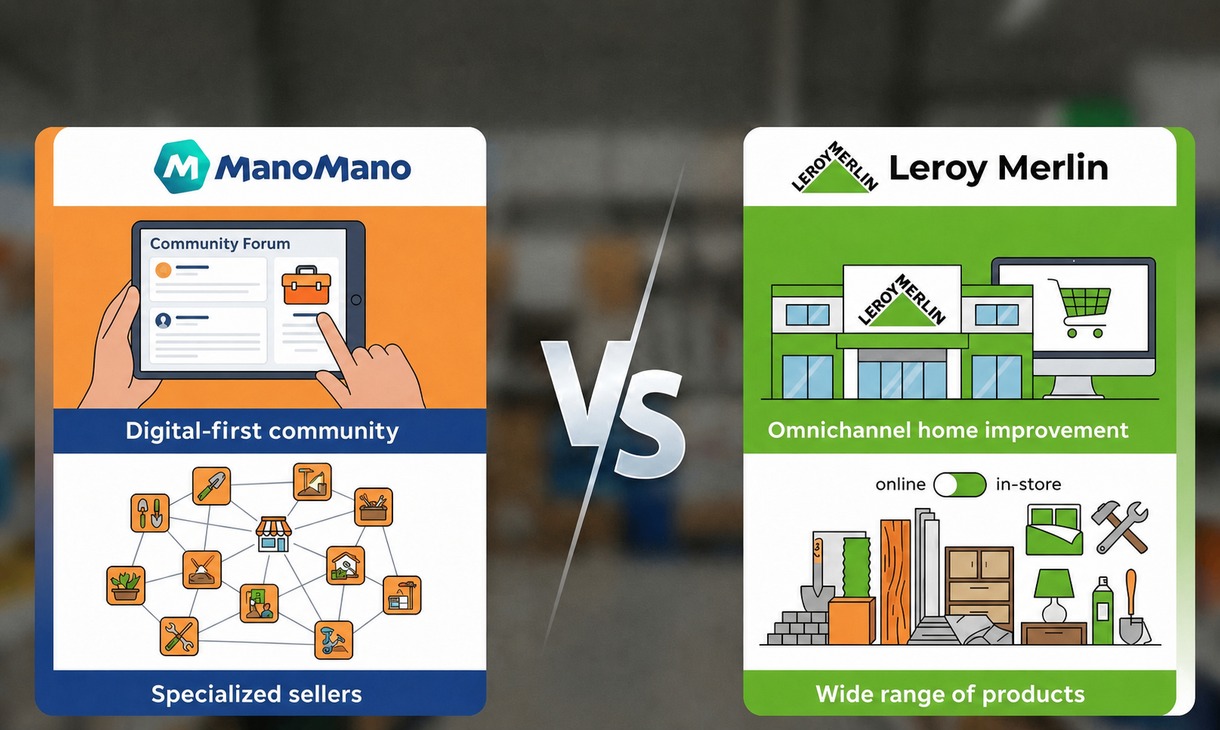
ManoMano vs Leroy Merlin: two marketplaces, two sales strategies compared
In the world of home improvement and do-it-yourself, ManoMano and Leroy Merlin today represent two reference channels in Europe.
They are often put on the same level, but in reality they respond to profoundly different logics.
Understanding these differences is essential for choosing how (and whether) to integrate them into your eCommerce strategy.
Origin of the marketplaces: digital vs retail
The first big difference is where they come from.
ManoMano was born as a pure online marketplaces, built around content, technical data sheets and communities.
Leroy Merlin was born from physical retail and brings online processes, standards and expectations typical of the store.
Architectural context: ERP, e-commerce and marketplaces integration in omnichannel contexts
Type of audience and purchasing behavior
The behavior of the end user is also different.

- very informed users
- technical comparison of products
- strong attention to specifications
- autonomous decisions
- digital orientation

- project-oriented users
- search for reliability and service
- confidence in brand retailer
- expectation of high standards
- omnichannel experience (online + shop)
This directly impacts:
- contents of the cards
- stock management
- customer experience
Catalogue requirements and data quality
Both require structured data, but with different goals.
On ManoMano, a well-made technical sheet improves visibility.
On Leroy Merlin, an incomplete sheet prevents publication or penalizes heavily.
In-depth analysis: How to centralize the catalog to avoid manual errors in multi-channel
Stock, reliability and operational expectations
Here one of the most relevant differences emerges.
- greater flexibility
- tolerate different logistic models
- ideal for testing and progressive growth
- reliable stock expectation
- stricter control
- Strong alignment with retail processes
This makes Leroy Merlin less forgiving, but more solid for those who are structured.
Strategic positioning of the seller
The two marketplaces respond to different objectives.
ManoMano is ideal if:
- have technical or specialized products
- want to value content and competence
- European digital growth circles
- works well on boards and variants
Leroy Merlin is ideal if:
- points on quality and reliability
- want to strengthen the brand
- ready to high standards
- works already in omnichannel optical
It's not an “either/or” choice
One of the most common mistakes is to think that ManoMano and Leroy Merlin are mutually exclusive.
In reality, they can coexist in a mature strategy:
- ManoMano → vertical digital channel
- Leroy Merlin → premium retail-driven channel
The difference is not the marketplaces, but the ability of the company to manage complexity, data and processes.
Technical fundamentals: ERP, e-commerce and marketplaces integration in omnichannel contexts
The decisive role of integration
Technical reference: Integration platform for complex eCommerce
Conclusion
ManoMano and Leroy Merlin are not direct competitors, but two different interpretations of the marketplaces.
- ManoMano rewards content, specialization and digital agility
- Leroy Merlin rewards reliability, quality and retail integration
The real question is not “which marketplaces to choose”, but:
Is my company ready to manage the model that that marketplaces requires?
When integration is solid, the answer can be: both.