ERP, e-commerce and marketplace integration in omnichannel contexts
In modern digital commerce, the problem is no longer selling online.
The problem is getting all the systems involved in the sale to communicate correctly.
In-depth analysis: Beyond the website: why an omnichannel strategy is crucial in 2026
ERP, e-commerce, marketplaces, logistics, payments and customer care can no longer function as separate silos. In an omnichannel context, any misalignment generates inefficiencies, operational errors and, in the worst case, loss of trust on the part of the customer.
For this reason, the integration between ERP, e-commerce and marketplaces is today one of the fundamental pillars of any sustainable growth strategy.
Because omnichannel is a problem of systems, not of channels
Many companies approach omnichannel starting from the channels:
- we open a new marketplaces
- let's add a second site
- we integrate social commerce
- we activate B2B and B2C sales in parallel
But each new channel introduces new data flows:
- products
- prices
- stock
- orders
- customers
- shipments
- billing
If these flows are not orchestrated by a coherent architecture, the result is inevitable:
increasing complexity, manual work and risk of error.
Omnichannel does not fail due to lack of opportunities, but due to the absence of structured integration.
In-depth information: How to centralize the catalog to avoid manual errors
The role of ERP: the source of truth
The e-commerce platform (Shopify, PrestaShop, WooCommerce, BigCommerce, etc.) represents the direct showcase of the brand.
For this reason, directly connecting ERP → marketplaces without an intermediate layer is often a dangerous shortcut.
Read more: ERP and eCommerce: why a management system is fundamental in an omnichannel strategy
The role of e-commerce: the controlled shop window
The e-commerce platform (Shopify, PrestaShop, WooCommerce, BigCommerce, etc.) represents the direct showcase of the brand.
In an omnichannel context, e-commerce cannot be an island, but must be a node in a larger system.
The role of marketplaces: demand multipliers (and complexity)
Marketplaces such as Amazon, eBay, ManoMano, Leroy Merlin, Decathlon or Immediately enormously amplify visibility and question.
Each marketplaces is an ecosystem in itself.
Managing them manually or in a "one-to-one" way with ERP or website quickly leads to an operational bottleneck.
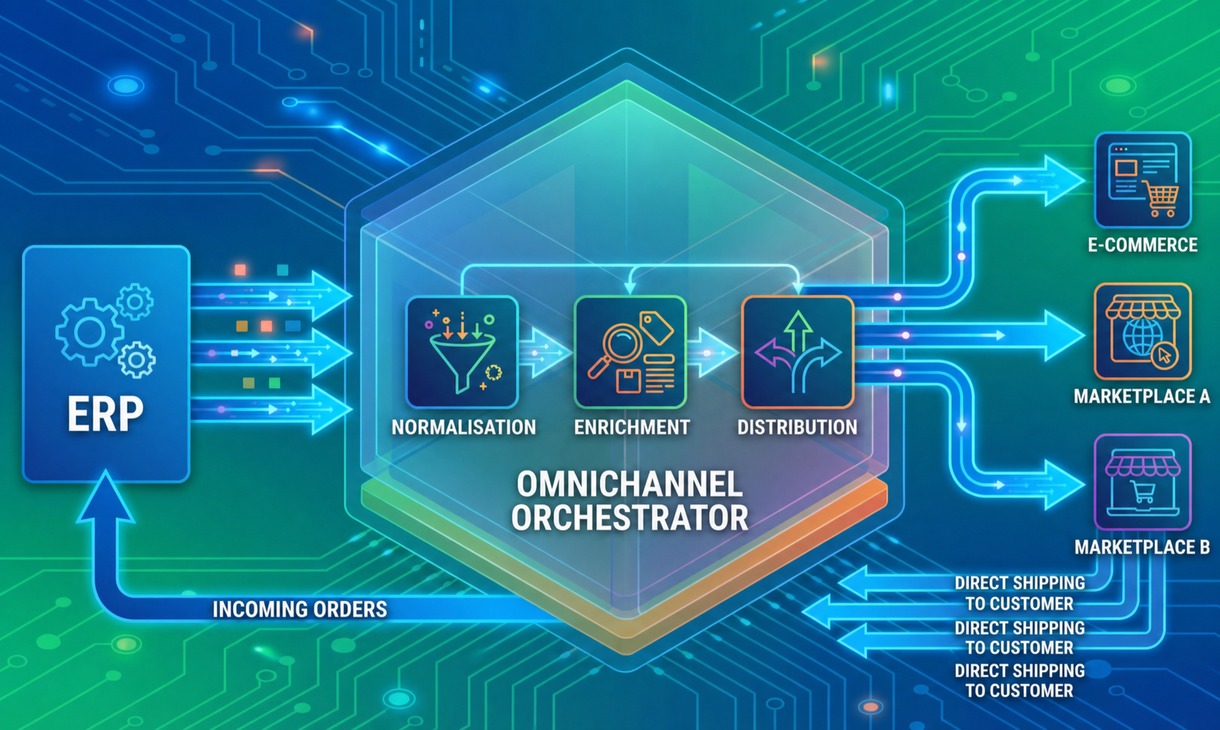
The real crux: the orchestration of flows
The critical point is not whether to integrate, but how to integrate.

In a mature omnichannel context, it serves a level of orchestration that:
- receive data from ERP
- They normalize
- enrich them for sale online
- distribute them correctly to e-commerce and marketplace
- collect orders from all channels
- send them back to ERP consistently
This level is neither ERP nor e-commerce.
It's one. integration layer designed to manage different complexity, volumes and rules.
In many cases, this level of orchestration is managed through specialized integration platforms, designed to coordinate ERP, e-commerce and marketplaces in a centralized way.
Technical in-depth analysis: Integration platform for complex eCommerce
Why “point-to-point” integrations don't scale
The correct approach: a centralized and modular ecosystem
Integration as a competitive advantage
In 2025 and beyond, the difference between those who scale and those who stop is not the number of channels, but the quality of integration.
Companies that invest in solid integration gain:
- fewer operational errors
- Faster time to market
- opening new channels without redoing everything
- greater reliability perceived by the customer
- operating costs under control
Integration is not a technical cost.
It is a strategic choice.
Conclusion
In a mature omnichannel context, the goal is not to choose the right channel, but to build an infrastructure capable of supporting any channel.
ERP, e-commerce and marketplaces are not alternatives, nor competing priorities. They are components of the same system that must function in a coherent, reliable and scalable way.
When the integration is well designed:
- adding a new marketplaces is not a complex project
- opening a new e-commerce site does not require rebuilding the flows
- selling abroad becomes a strategic choice, not an operational risk
- the company maintains control, even by increasing the channels
The real strength of an omnichannel ecosystem is not where you sell, but how easily you can sell everywhere.
And it is precisely the integration — between ERP, e-commerce and marketplaces — that makes this freedom possible.
Amazon, eBay, Shopify, PrestaShop, WooCommerce, Decathlon, BigCommerce, ERP, Leroy Merlin, ManoMano, CRM, Marketplace, Logivery