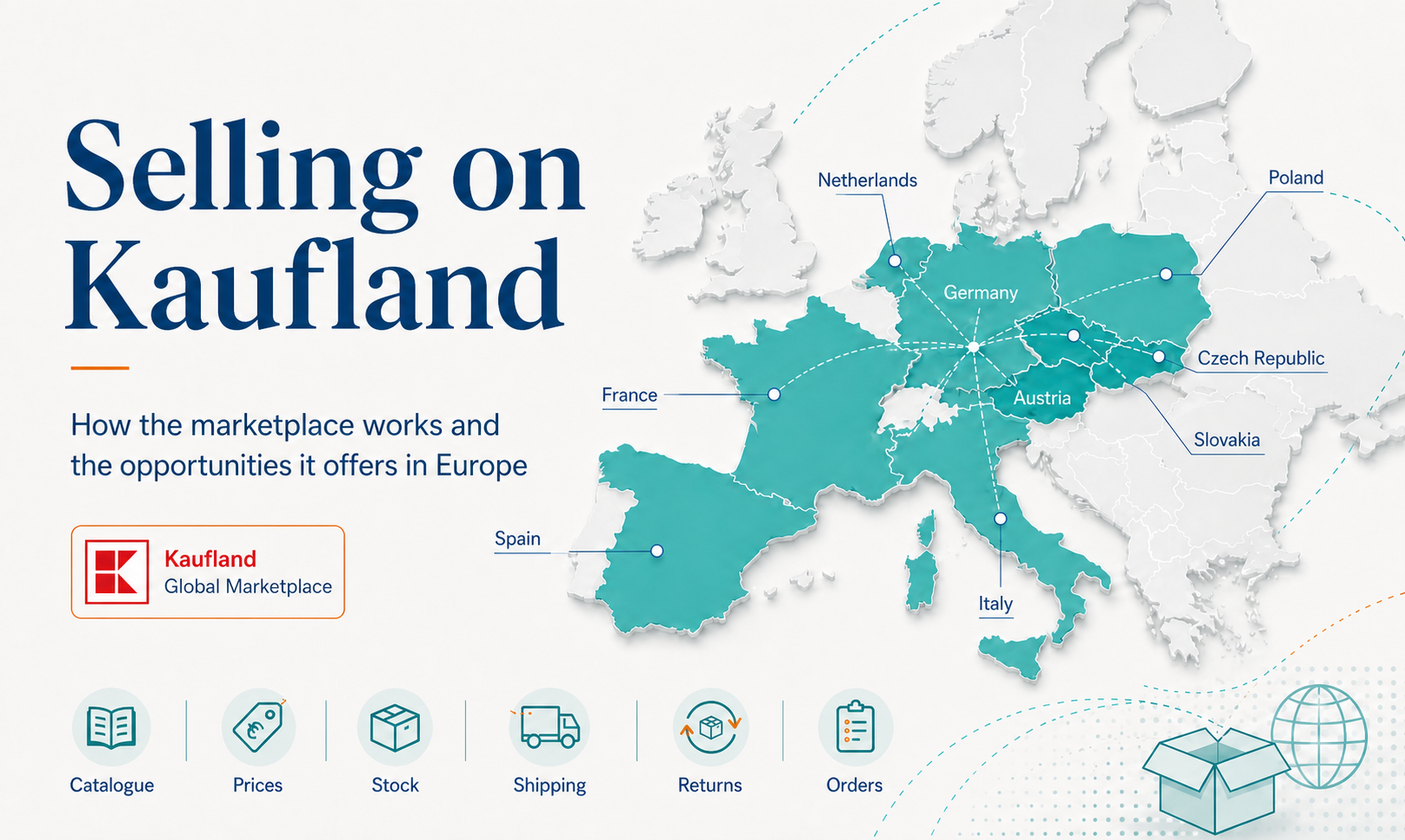
Selling on Kaufland: How the Marketplace Works and the Opportunities It Offers in Europe
Kaufland Global Marketplace has become one of the most interesting options for businesses that want to expand online sales in Europe without opening and managing a separate marketplace account for every country.
What is Kaufland Global Marketplace?
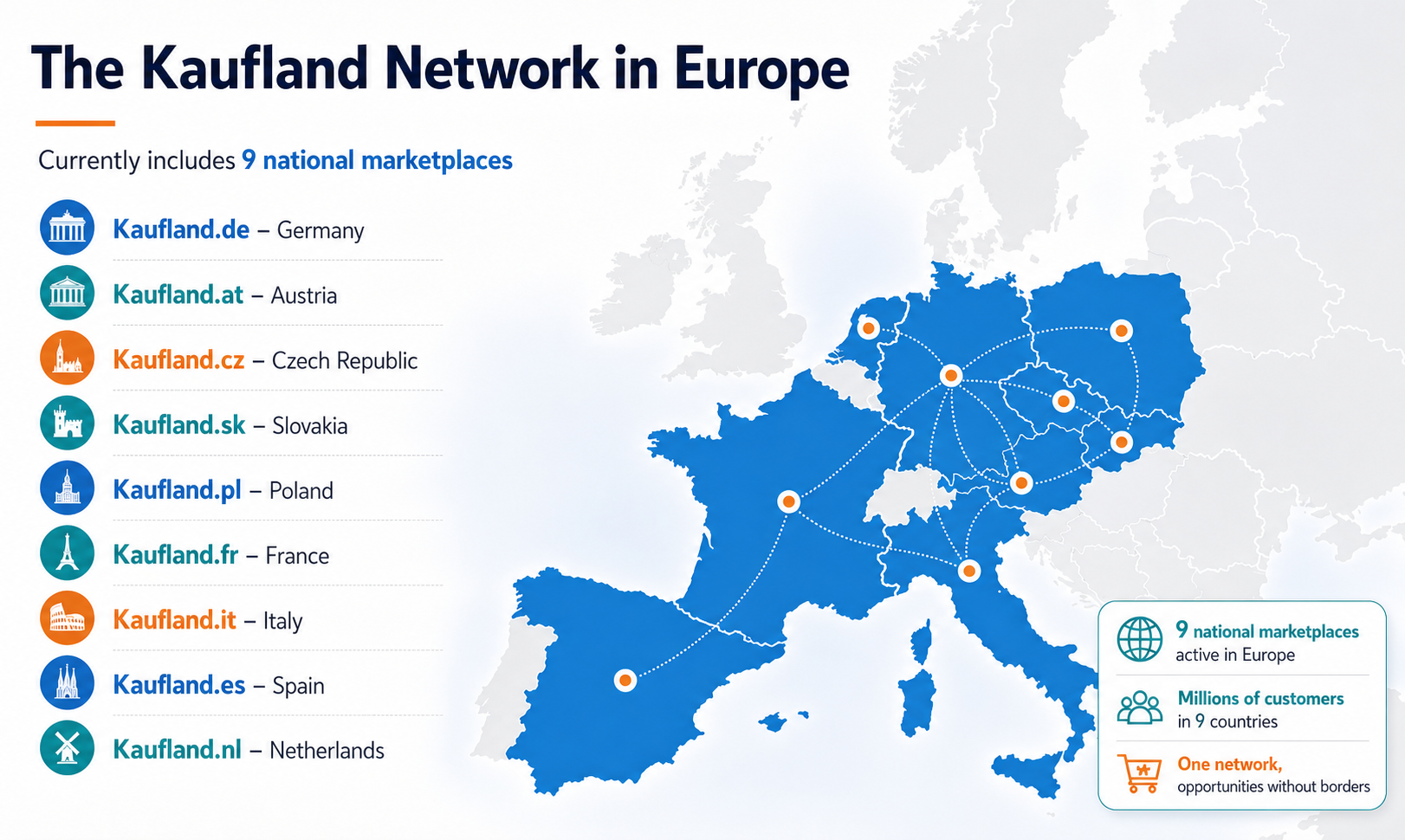
Kaufland Global Marketplace is the marketplace infrastructure connected to the Kaufland brand. Professional sellers register once and use the same environment to operate across the available national marketplaces: Germany, Austria, the Czech Republic, Slovakia, Poland, France, Italy, Spain and the Netherlands.
The benefit is not only the number of countries that can be reached, but the ability to manage them through one operating structure. Sellers can test one or two countries, measure sales and margins, then expand gradually.
Which businesses can sell on Kaufland?
Kaufland is aimed at professional sellers. Registration requires company and tax information, seller details and documentation to verify the business. Check correct EAN/GTIN identifiers, product compliance, tax data and EPR obligations, legal documentation, and the ability to manage customer service, shipping and returns.
For European sellers, the OSS scheme can simplify VAT management for cross-border B2C sales, but the specific tax position should always be assessed according to the business structure, countries served and any stock held abroad.
How much does it cost to sell on Kaufland?
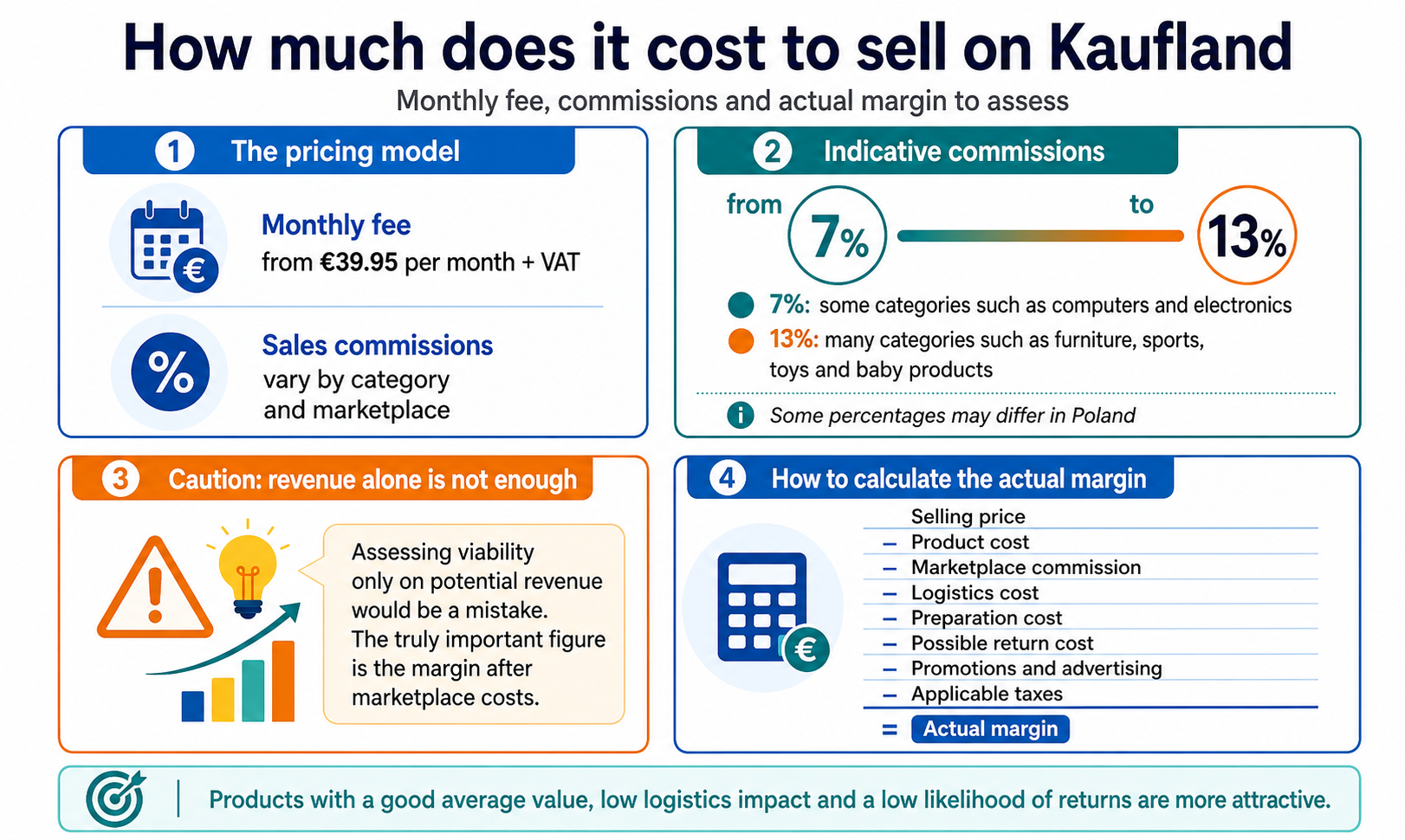
The pricing model includes a monthly fee and sales commissions. Kaufland currently lists a basic plan from €39.95 per month plus VAT, in addition to transaction commissions. Percentages vary by product category and, in some cases, by marketplace.
The key figure is the margin after marketplace costs
Selling price − product cost − marketplace commission − logistics cost − preparation cost − possible return cost − promotions and advertising − applicable taxes = actual margin.
A product with a good margin on an e-commerce site may become less profitable when sold abroad through a marketplace. Products with a good average value, low logistics impact and a low likelihood of returns can be particularly attractive.
There is not necessarily one single European price
Being present on nine marketplaces does not mean the same product should be sold at the same price in every country. Prices may vary according to commissions, shipping costs, VAT, local competition, purchasing power, return costs, promotional strategy and target margin.
Catalogue: one of the most underestimated areas
Opening a marketplace account is relatively straightforward; preparing the catalogue properly is far more demanding. Kaufland distinguishes between product data and offer data, including price, delivery time and item condition. Manage EAN/GTIN codes, titles, descriptions, images, categories, attributes, variants, technical specifications, prices and availability accurately. Localising content is also essential when selling in multiple countries.
Categories, stock and shipping
Kaufland lists more than 6,400 categories, including electronics, home appliances, furniture, lighting, DIY, garden, sports, bicycles, automotive, health and personal care, baby products, toys, groceries and media. The best category depends on country demand, competition, commission levels and logistics cost.
As channels increase, stock management becomes critical. Sellers must avoid overselling, cancellations, delays and a decline in seller performance. Before publishing offers, configure shipping groups: countries served, shipping costs, additional charges, transit times, delivery types and free-shipping thresholds.
Returns, payouts and international organisation
Returns are one of the most important financial considerations for an international marketplace. Before opening a country, define return destinations, reverse-logistics costs, refund times, returned-product handling and when a returnless refund is more economical.
According to the platform flow, sales proceeds are available in the Seller Portal 14 days after delivery, then can be transferred to the company account. Consider this in financial planning, especially with high product costs, long delivery times, high volumes or limited working capital.
Selling abroad requires organisation, not just translation
Catalogue → prices → stock → orders → warehouse → shipping → tracking → customer service → returns → administration.
Review product-data sources, stock location, order imports, shipment preparation, tracking updates, customer requests, returns and country-level margin calculation before expanding.
Should you open every country at once?
For many SMEs, a gradual approach is more prudent: select one or two countries based on demand, competition, logistics cost and margin; start with a pilot catalogue; measure sales, conversion, costs, cancellations, returns and customer service; optimise; then expand catalogue and markets.
Can Kaufland be attractive for an Italian seller?
Potentially yes, particularly for businesses with a structured catalogue, correct GTIN/EANs, sufficient margins, the ability to ship abroad, reliable stock, order-management procedures, a returns strategy and resources to localise content.
The right question is not simply “Is it worth selling on Kaufland?”, but “Which products, in which countries and with what cost structure can be genuinely competitive on Kaufland?”