Verified reviews for eCommerce: how to increase trust, SEO and conversions
Online reviews have become one of the most important elements in a customer's purchasing journey. Before choosing a product, service or brand, users look for confirmation: they read the experiences of other customers, compare ratings, observe the number of available reviews and evaluate how authentic those opinions seem.
For an eCommerce, reviews are no longer a simple detail to be shown at the bottom of the product sheet. They are a strategic lever that can influence trust, conversion rate, visibility on Google and the overall reputation of the brand.
The point, however, is not just "having reviews". True value arises when reviews are collected in a structured way, verified, published in the right places and transformed into useful content to sell better.
Professional review management allows you to bring the voice of customers into the sales process, making it visible, verifiable and useful for both those who purchase and those who manage the brand.
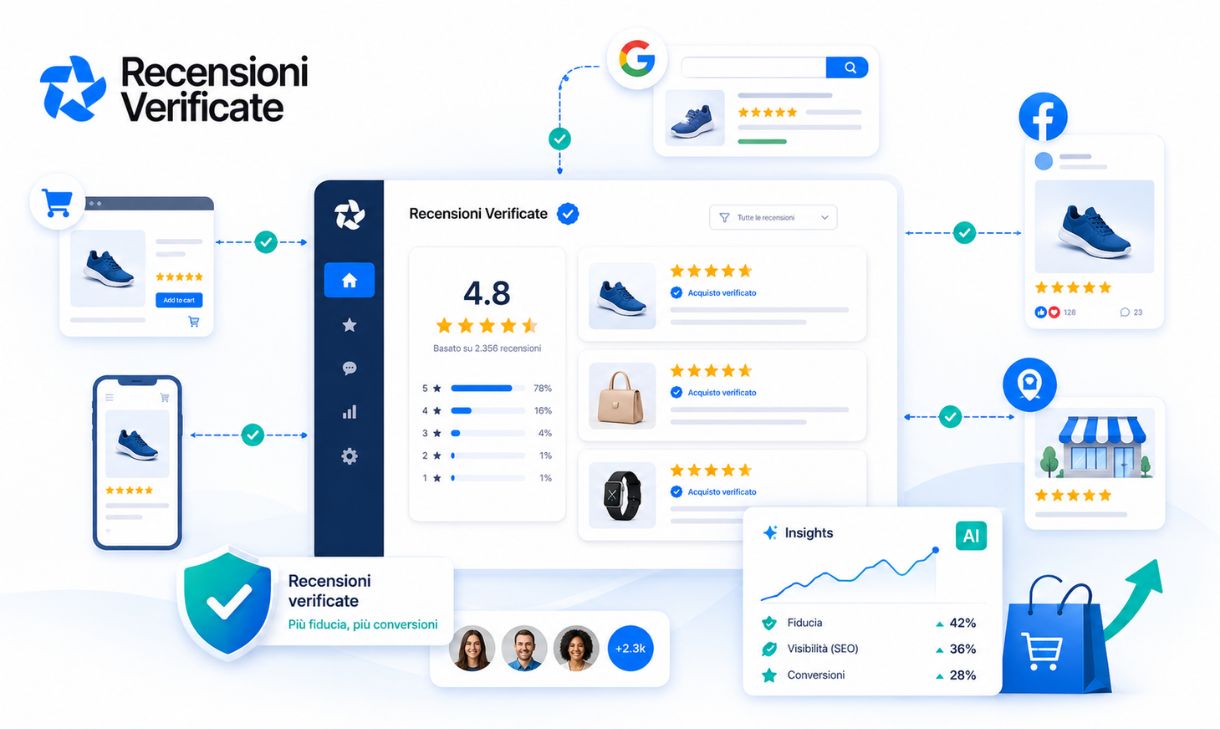
With Verified Reviews, an eCommerce can collect authentic feedback, publish them in the most relevant points of the site and turn them into a concrete leverage for trust, SEO and conversions.
When a customer buys online, he cannot touch the product, try it, speak directly with a seller or physically assess the quality of the service. For this reason, the opinions of other customers become a form of social proof.
A product card with visible, up-to-date and reliable reviews can help you overcome many doubts:
Does the product really match the description?
size, material or quality are expected?
is the delivery service reliable?
Does the brand respond to customers in case of problems?
Have other users had a good shopping experience?
Reviews help reduce uncertainty. And less uncertainty often means more propensity to purchase.
But there is also a second aspect: reviews do not only serve the final customer. They also serve the company. Each feedback contains valuable information about product, service, logistics, customer support, perceived quality, packaging and communication.
An effective review management system allows you to transform customer opinions into useful data to improve eCommerce.
The problem of unmanaged reviews
Many brands collect reviews in a disorderly manner. Some come to Google, others on marketplaces, others on social media, via email, comments or through customer care.
The result is often fragmented:
reviews scattered on multiple platforms
difficulty in responding promptly
poor visibility of reviews in product cards
absence of a certified moderation process
inability to analyze feedback in a structured way
loss of useful content for SEO and conversions
In some cases, reviews remain isolated where they were left. They are not included on the site, they do not enrich the product pages, they do not help Google Shopping, do not feed internal reports and do not become a resource to improve customer experience.
In other cases, the problem is opposite: the brand receives negative or incorrect feedback, but does not have a clear process to manage, respond, report any untruthful content or enhance positive reviews.
For this reason, review management must be considered an integral part of the eCommerce strategy.
What are the verified reviews
The verified reviews are collected through a controlled process, connected to a real customer experience and managed according to clear rules of collection, moderation and publication.
The difference with a simple free review is important. A verified review offers greater reliability because it is inserted within a structured process, designed for protect both the consumer and the company.
For a brand, this means you can show more credible reviews. For the customer, it means being able to read more useful and transparent opinions.
Verified Reviews allows you to manage brand reviews, product and sales points, with the aim of collecting authentic feedback and making them usable in the different digital touchpoints: eCommerce site, product cards, Google, local pages, advertising campaigns and other channels.
Why choose Reviews Check with other review platforms
There are several solutions on the market to collect online reviews. Some are well known especially as public brand reputation platforms, others are designed to show generic evaluations or collect feedback in a simpler way.
For an eCommerce, however, review management often requires something more specific: it is not enough to have a public page with a rating. It serves a platform capable of collecting authentic reviews after purchase, posting them in product cards, value them on Google, manage brand reviews, product and point of sale, and turn feedback into useful information to improve business.
Verified Reviews is particularly interesting because it works on this operating level.
Among the aspects to consider are:
focus on authentic and verified reviews, collected through structured processes;
brand reviews, product and point of sale, useful for both pure eCommerce and for omnichannel retailer;
publication of reviews in product cards, where they can directly affect the purchase decision;
Google visibility and support for SEO and advertising activities, thanks to the enhancement of reviews at points where the customer is looking for information;
moderation and reporting management, to protect the quality of the published content;
AI functionality, useful to respond to reviews, synthesize feedback, analyze sentiment and identify recurring themes;
reporting tools, to transform reviews into useful data on products, customer experience, points of sale and performance.
The choice of the review platform should not be based solely on the brand’s reputation or service cost, but on the company’s real goal.
If the need is simply to show a public rating, there may be several alternatives. If instead the goal is to use reviews as leverage to increase confidence, improve product cards, strengthen Google presence and get useful insights from customers, Verified Reviews is a solution to be carefully evaluated.
The starting point is the real customer experience. Purchase can happen online, in store or through hybrid mode like click & collect.
This is an important aspect because it allows the brand to collect reviews not only on eCommerce, but also on the overall experience offered to the customer.
2. Automated review collection
After purchase, the customer can receive a review request through automated touchpoints, such as email, web or SMS.
This allows you to overcome one of the most common limits: manual or occasional collection of feedback. Automate your request allows you to increase the number of reviews collected and maintain a constant flow of updated content.
In addition, the collection can be customized according to the brand’s needs, with dedicated formulations, specific KPIs and graphically consistent communications with corporate identity.
3. Moderation
Moderation is a central phase of the process. Reviews can be managed according to defined rules, with the possibility to report content considered untruthful and attach elements to support.
This does not mean eliminating negative reviews. On the contrary, correct management of reviews must maintain transparency and credibility. Negative reviews can be published together with the customer care response, transforming criticality into an opportunity to dialogue with the customer.
The value for the company is not in showing only positive opinions, but in showing attention, seriousness and responsiveness.
4. Publication
Once collected and managed, reviews can be published at points where they have greater impact:
website homepage;
product cards;
pages dedicated to brand rating;
local pages or stores;
Google;
social networks;
advertising campaigns.
This phase is crucial because it makes reviews really useful. A hidden review in an internal dashboard has a limited value. A visible review at the time when the customer is deciding whether to buy can directly affect the purchasing behaviour.
Product reviews: why improve eCommerce cards
The product cards are one of the most important points of an eCommerce. It is there that the customer decides whether to add the product to the cart or to leave the page.
Integrating product reviews directly into the tab allows you to enrich the content with real information from customers. This is particularly useful for categories such as fashion, beauty, electronics, home, food and technical products, where the user experience can clarify doubts that the standard description cannot cover.
Reviews can help you answer practical questions:
the product dresses large or small?
is the material resistant?
Does the color match the images?
is the product easy to use?
is the perceived quality consistent with the price?
In this sense, the product reviews are not just an element of trust. They are also informative content that complete the product sheet and reduce the load on the customer care.
An eCommerce showing relevant reviews in the product card communicates greater transparency and helps the customer make more aware decisions.
Reviews, SEO and Google: a link not to be underestimated
Reviews can also impact organic visibility and campaign performance.
On the one hand, reviews can contribute to the enrichment of the product pages with updated and relevant content. On the other hand, integration with tools like Google Shopping and Google Seller Ratings can help the brand to show ratings and trusted signals even in search results and ads.
For an eCommerce, this can affect different levels:
best brand perception in Google results;
greater confidence in ads;
richer product cards;
visible reviews in user path decision points;
support for Shopping and Product Listing Ads campaigns;
increase of the perceived quality of the offer.
Of course, reviews do not replace a full SEO strategy. We still need quality content, correct technical structure, site performance, well organized catalog and consistent product data.
However, reviews represent a content generated by users that can strengthen eCommerce pages and increase confidence in the brand.
According to the data presented by Verified Reviews, the platform highlights benefits related to visibility, SEO traffic and conversion rates. As always, the results can vary according to the industry, the volume of reviews, the quality of the site and the overall strategy of the brand.
Widget reviews: bring trust into the site
One of the most useful aspects for an eCommerce is the possibility to publish reviews directly within the site.
Widget reviews can be used in different points:
homepage;
category pages;
product cards;
pages dedicated to the brand;
store locator;
commercial landing page.
This allows you to bring trust to the exact point where the customer is evaluating the purchase.
In particular, the product widget allows you to show specific reviews about a given article, while multi-critery widgets can collect ratings on more detailed aspects such as quality, fit, relationship with description, ease of use or other relevant items for the industry.
For many eCommerce, this is an important difference: not all reviews are equal. A generic review on the brand helps the overall reputation, but a specific product review can directly affect your purchase decision.
Centralized management of Google reviews
Another interesting aspect is the possibility to centrally manage even Google reviews.
For companies with multiple stores or multiple locations, responding manually to reviews on Google Business Profile can become complex. Each store can receive different feedback, often with difficult volumes to monitor.
A centralized management allows:
view reviews in one environment;
respond faster;
monitor the reputation of different stores;
maintain consistency in the response tone;
use AI to support the generation of relevant responses;
show attention to customers even after purchase.
Respond to reviews is not just a good practice of customer care. It's also a public signal. A brand that responds carefully demonstrates listening to customers and taking seriously the feedback received.
AI functionality: from reviews to useful data for business
One of the most interesting aspects of modern reviews management platforms is the use of artificial intelligence.
In the case of Verified Reviews, AI features can support different activities.
Assisted responses
The AI can help generate customized responses to reviews, speeding up customer care work and keeping a tone consistent with the brand.
This is particularly useful when the volume of reviews grows or when the company has to manage multiple languages, markets or more points of sale.
Multilanguage support
For international eCommerce, language is an important theme. The ability to generate or adapt answers based on the language of the review helps to offer a more natural and localized experience.
Summary of reviews
When a product receives many reviews, the customer does not always have time to read them all. A summary of the recurring elements can help to quickly highlight the most important points: quality, fit, ease of use, frequent problems, appreciated aspects.
Intelligent Insight
Reviews contain valuable signals. AI can help identify positive and negative aspects, key concepts, recurring themes and general sentiment.
This transforms the review from simple content published on the site to an analysis tool.
Sentiment detection
Understanding the sentiment of reviews allows you to quickly locate critical areas or strengths. For example, a product may have a good average rating but contain many reports on a specific detail, such as size, packaging or delivery times.
Without a structured analysis, these signals can go unnoticed.
Internal reviews Syndication
For brands operating on multiple stores, languages or markets, another important issue is the syndication of reviews.
The syndication allows you to share product or brand reviews between different stores, channels or language versions, avoiding that every new market starts from scratch.
This can be useful when:
a brand sells the same product in several countries;
the site is multilanguage;
some product cards still have few content;
you want to accelerate penetration in new markets;
you want to value the heritage of reviews already collected.
In an international context, reviews become a reusable asset, able to support trust even on newly opened markets.
Performance Reports and Analysis
Reviews should not only be considered as content to be published. I'm also a source of data.
A structured platform can help the company analyze:
volume of reviews collected;
average rating;
time;
performance for product;
performance by point of sale;
themes more quoted by customers;
sentiment of comments;
recurring critical areas;
differences between brand reviews, product and Google.
This data can support decisions on catalog, customer care, logistics, packaging, product descriptions, quality and business.
For example, if many reviews report size issues, the company can improve driving to sizes. If there are often critical issues on delivery, it can intervene on logistics. If some products receive very positive feedback, they can be valued in marketing campaigns.
Reviews and omnichannels
Reviews are not just about pure eCommerce. Many brands today sell through multiple channels:
site owner;
marketplace;
physical shops;
affiliated sales points;
social commerce;
Google Shopping;
advertising campaigns.
In an omnichannel context, reputation must be managed consistently. A customer can discover the brand on Google, compare a product on the site, buy it in the store and leave an online review.
This is why it is useful to have a system capable of connecting brand reviews, product and point of sale, maintaining a more complete vision of the customer experience.
To whom can be useful Reviews Verified
A review management solution can be useful to different types of companies.
eCommerce growing
For an eCommerce that is increasing traffic, orders and catalog, reviews help build confidence and improve the conversion of product cards.
Brand with many products
The more the catalog is wide, the more important it becomes to collect specific product reviews. The generic opinions on the brand are not enough: the customer wants to know how to behave that specific product.
Retailer with physical stores
Companies with physical stores can use reviews to enhance the local experience, monitor satisfaction at different points of sale and strengthen presence on Google.
Companies investing in Google Ads and Google Shopping
For those investing in advertising, reviews can become a visible element of trust even in campaigns, helping to improve the perception of ads.
International Brands
Multilanguage features, reviews syndication and the ability to reuse already collected content can be particularly interesting for those who sell in multiple countries.
dirCommerce deals with tools, solutions and strategies to help companies in sell best online. In this context, review management is a central theme.
An eCommerce can have a good product, a fast site and well structured campaigns, but if there is no confidence in the purchase path remains incomplete.
The verified reviews help fill this space: they bring the customer's voice into the sales process, make the product cards more credible and offer the brand useful data to improve.
That's why Verified Reviews can be an interesting solution for many eCommerce, especially for those who want professionally structured the collection, publication and analysis of reviews.
Bring verified reviews to your eCommerce
If you sell online, customer reviews can help you build trust, improve product cards, strengthen brand reputation and support SEO and Google Shopping activities.
Verified Reviews allows you to collect, manage, publish and analyze authentic reviews through a structured platform, designed for eCommerce, retailer and omnichannel brands.
Reviews are one of the most powerful forms of content generated by users. They tell the real experience of customers, help other users decide, increase confidence and can contribute to the visibility of eCommerce.
But because they really work, they have to be managed by method.
Collecting authentic reviews, moderate them correctly, posting them in the right points and analyzing them with advanced tools allows you to transform customer feedback into a business asset.
For eCommerce who want to grow, improve online reputation and enhance the voice of its customers, a platform like Verified Reviews can represent a concrete support.