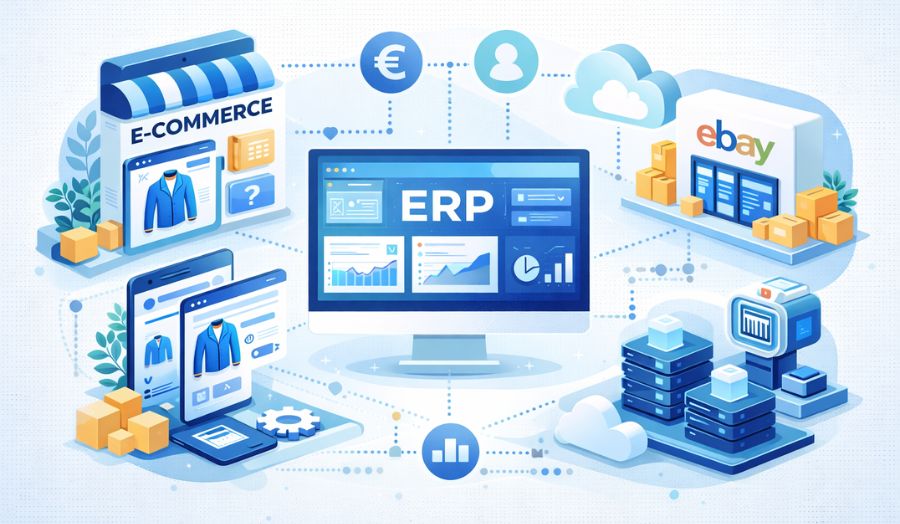
ERP and eCommerce: Why a Management System Is Essential to an Omnichannel Strategy
When an e-commerce project grows, one of the most common mistakes is to consider online store as a self-sufficient system.
In fact, in structured contexts, e-commerce is only one of sales channels, while the real operating heart is the company management (ERP).
Understanding the role of ERP in an omnichannel strategy is essential to avoid scalability problems, stock disalignments and operational inefficiencies.
What is an ERP and why it is central
An ERP (Enterprise Resource Planning) is the system that governs the company’s key processes, including:
- orders
- stock and availability
- billing and accounting
- logistics and operational flows
- product and customer records
In an omnichannel context, the ERP becomes the single source of truth, that is the only reliable point on which all other systems depend.
The limit of an e-commerce without ERP
When e-commerce is not properly integrated with a central management, critical issues such as:
- stock not aligned between channels
- duplicate or lost orders
- difficulty in administrative management
- impossible to scale on multiple marketplaces
- manual and uncontrolled processes
These issues do not depend on the e-commerce platform itself, but on the absence of a central governance of data.
ERP and e-commerce: different roles, complementary
In a well-designed architecture:
the CMS e-commerce manages:
- user experience
- catalogue for the direct channel
- cart and checkout
theERP manages:
- overall orders
- real availability
- accounting and logistics processes
E-commerce does not replace ERP and ERP does not replace e-commerce.
They are systems complementary, not alternative.
ERP and omnichannel strategy
When a company sells on multiple channels — online store, marketplaces, B2B, retail — ERP is the only tool that can:
- have a unified vision of sales
- coordinate flows between different channels
- avoid conflicts of availability
- support reliable data-based strategic decisions
Without a central ERP, the omnichannel quickly becomes unmanageable.
Modern ERP and integration with e-commerce
Modern ERPs, like Microsoft Dynamics 365 Business Central, they are designed to integrate with e-commerce platforms and external systems.
This allows:
- receive orders from multiple channels
- update availability in almost real time
- centralizing administrative processes
- maintain a modular and scalable structure
In this model, the ERP governs business, while sales channels remain flexible and interchangeable.
Projects omnichannel structured, integration between ERP, e-commerce platforms and marketplaces is generally managed through a dedicated integration layer, which allows you to coordinate and normalize flows between different systems.
Technical study: ERP and e-commerce integration in omnichannel contexts
ERP, e-commerce and integration systems
In structured omnichannel projects, the integration between ERP, e-commerce and marketplaces does not happen directly and “artisanal”, but through a dedicated integration layer.
This approach allows:
- normalize data
- manage business exceptions and rules
- avoid rigid dependencies between systems
- facilitating the evolution of architecture over time
It is one of the key elements for long-term stability of a digital ecosystem.
When ERP becomes indispensable
An ERP is not always necessary in the initial phase, but becomes fundamental when:
- the volume of orders grows
- increase sales channels
- marketplaces and B2B come into play
- need more stringent administrative controls
- e-commerce becomes a strategic channel
In these cases, continuing without a central management means accumulating operational debt.
CMS eCommerce, Microsoft Dynamics 365 Business Central, ERP, Omnichannel