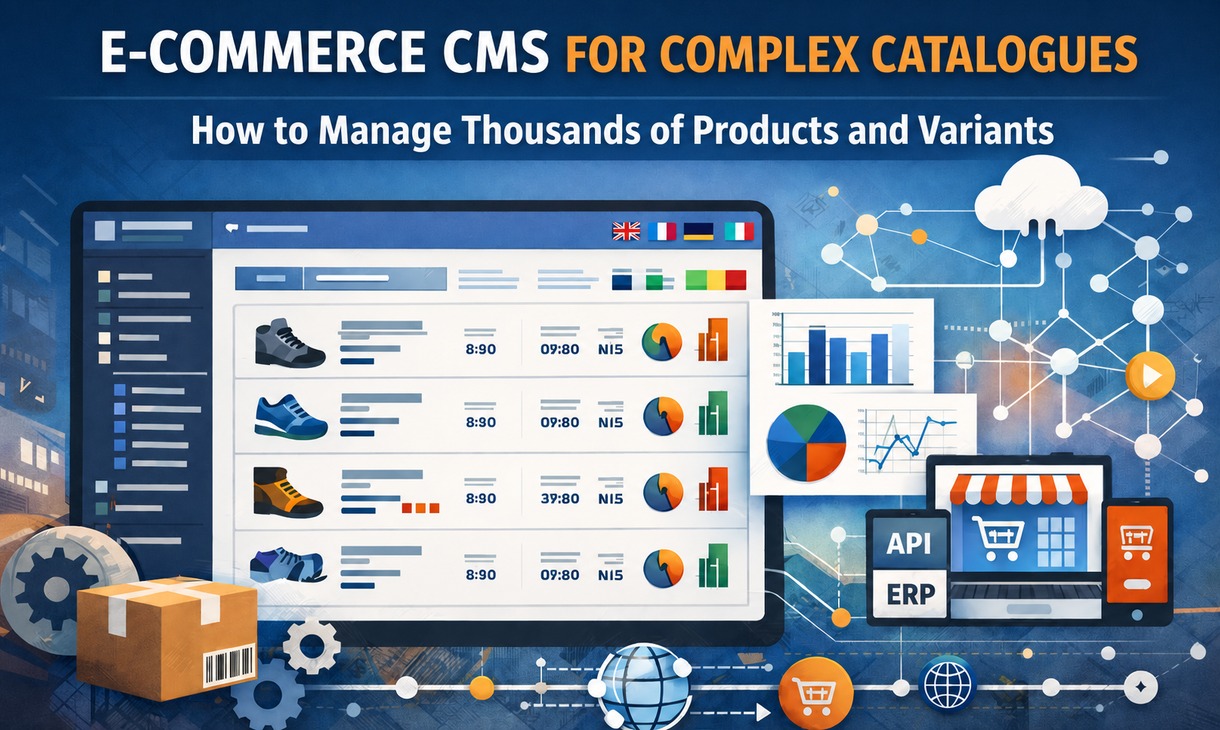
CMS e-commerce for complex catalogs: how to manage thousands of products and variants
When an e-commerce grows, complexity not only increases in the number of products, but above all in catalogue structure.
Thousands of SKUs, technical variations, specific attributes, multiple languages and channels quickly transform an online store into an articulated system, requiring appropriate tools.
In these contexts, the CMS e-commerce is no longer just a showcase, but it becomes a central element of operational architecture.
What makes an e-commerce catalog “complex”
A catalogue can be defined as complex when it has one or more of these features:
- thousands or tens of thousands of SKUs
- technical products with specific attributes (measures, materials, compositions)
- numerous variants for single product
- deep and very vertical categories
- mix of own products and third parties
- frequent price and availability updates
- need to publish on more channels
It is the typical case of specialized e-commerce: gardening, bricolage, components, B2B, technical supplies, outdoor or professional sectors.
The limits of CMS designed for simple catalogues
Many CMS work very well for:
- reduced catalogues
- standardized products
- linear sales logic
But they start showing limits when:
- the catalogue grows quickly
- variants become numerous
- need more languages
- enter the game marketplaces and other channels
In these cases problems arise as:
- duplication of products
- manual management of variants
- stock errors
- maintenance difficulties over time
The basic features of a CMS for complex catalogs
A CMS e-commerce suitable for complex catalogs must offer some key features.
1. Advanced category management
- multilevel categories
- flexible structures
- possibility to reuse products in multiple contexts
- clear navigation also with thousands of references
2. Solid system of attributes and variants
- structured and reusable attributes
- manageable combinations without duplicating products
- clear rules on price, stock and visibility
- reduction of “artificial” SKUs
This is one of the most critical areas in complex catalogs.
3. Rich and structured product patterns
- customizable fields
- extensive technical descriptions
- documentation, instructions and media support
- consistency of data on the entire catalogue
4. Real multilanguage support
Not only translations of texts, but:
- consistent language management
- adaptation of content by market
- URL, SEO and navigation control
- scalability in new countries
5. Performance and stability
With large catalogues:
- loading times become critical
- Database queries increase
- CMS must hold high loads
Performance is not an “extra”, but a structural requirement.
CMS and automation: an indispensable combination
When the catalog is complex, the CMS cannot work alone.
It must be able to dialogue with other systems:
- Administrative management
- warehouse
- pricing systems
- marketplaces
- integration tools
A CMS suitable for complex catalogs must:
- expose reliable APIs
- support frequent synchronization
- insert into modular architectures
In more structured projects, integration between CMS, ERP, marketplaces and external systems is generally managed through a dedicated integration layer, which allows to coordinate and normalize flows between different platforms.
In depth: ERP and e-commerce: why a management is fundamental in an omnichannel strategy
Technical study: Integration platform for complex e-commerce
CMS and omnichannel strategy
A complex catalog rarely lives on a single channel.
Often the same products are sold on:
The CMS must therefore:
- manage the direct channel
- adapt to an omnichannel strategy
- avoid role overlaps with ERP and external systems
In depth: omnichannel strategy: how to integrate online sales and marketplaces
A concrete example: the Geosism case
In case study Geosism, the management of an extremely wide and specialized catalog requires:
- thousands of technical products
- numerous variants
- Six languages
- sale on multiple European marketplaces
A context of this type makes it clear that the choice of a CMS suitable for complex catalogues is a determining factor in the sustainability of the project.
Real case: Case study Geosism — manage a complex catalog and sell in omnichannel at European level
PrestaShop as an example of CMS for complex catalogs
In the European landscape, PrestaShop is often used in projects with articulated catalogs, thanks to:
- Advanced management of categories and attributes
- multilingual support
- flexibility through modules
- adaptability to vertical contexts
In cases such as Geosism, PrestaShop represents a concrete example of CMS able to support complex catalogs, if inserted in a well designed architecture.
From “how” to “what CMS to choose”
This article aims to clarify what features must have an e-commerce CMS to manage complex catalogues, thousands of products and numerous variations.
Once these requirements are met, the next step is to assess which e-commerce platform best meets these needs, based on factors such as catalog size, sales channels, internal organization and growth objectives.
In depth: How to choose the right CMS for an e-commerce project with complex catalogs
Conclusion
Managing thousands of products and variants is not only a technical challenge, but organization.
A CMS e-commerce suitable for complex catalogs must offer structure, flexibility and integration capabilities, avoiding the growth of the catalogue becoming an operational brake.
Understanding what characteristics really need It's the first step.
Only then does it make sense to address the theme of the most suitable platform choice.