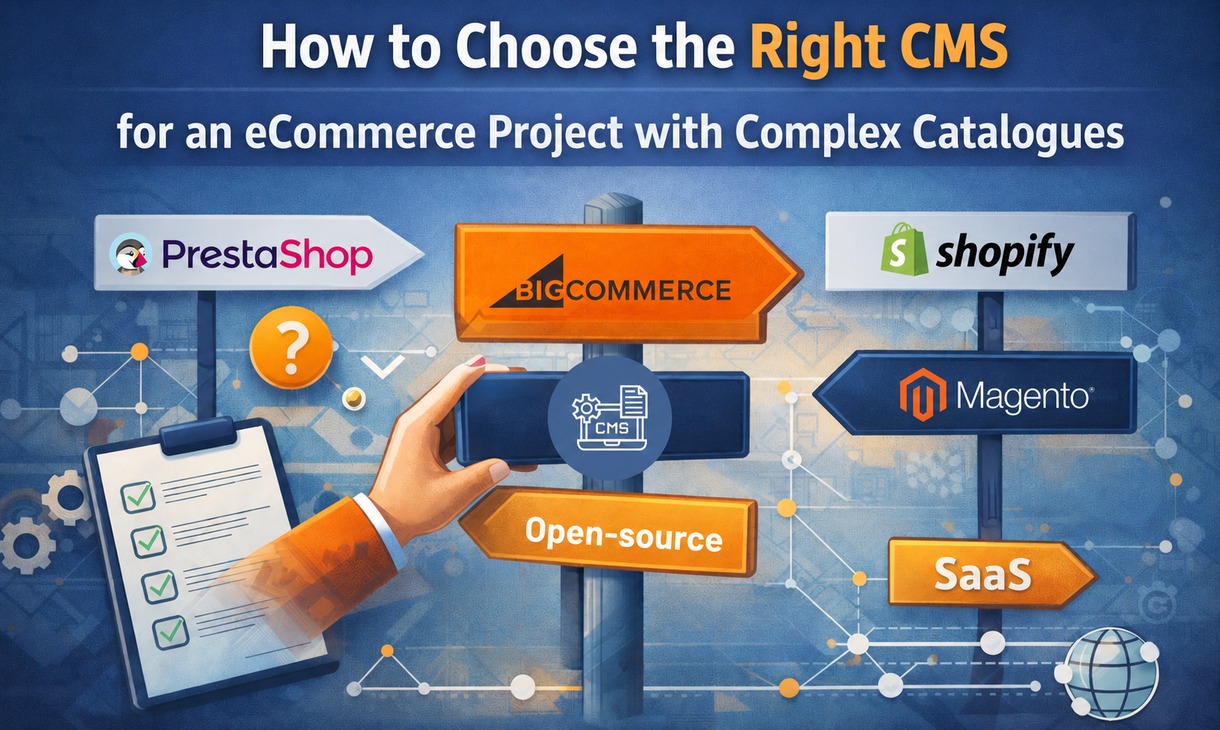
How to choose the right CMS for an e-commerce project with complex catalogs
After clarifying what features must have an e-commerce CMS to manage thousands of products, variants and additions, comes the most delicate moment: choose the right platform.
This decision does not depend on a single function, but on the balance between:
- complexity of the catalogue
- sales strategy
- internal organization
- Growth objectives
There is no “best in absolute” CMS, but the CMS most suitable for a specific context.
Before choosing: starting from the requirements
Choosing a CMS should always start from the real requirements of the project, not from the platform name.
Key factors to evaluate
1. Catalog structure
Very structured catalogs require CMS with advanced management of attributes and variants.
2. Multilanguage and internationalization
Not all CMS manage multilanguage at the same level.
3. Sales strategy: only store or omnichannel?
In depth: omnichannel strategy: how to integrate online sales and marketplaces
4. Integration with ERP and external systems
In complex projects, the CMS It's not the central system.
In depth: ERP and e-commerce: why a management is fundamental in an omnichannel strategy
CMS open-source vs CMS SaaS
One of the first two is between open-source and Saa.
In summary: the choice depends on complexity, internal resources and growth roadmaps.
CMS suitable for complex catalogs (by scenario)
The role of integration (decisive factor)
Many projects fail not for the chosen CMS, but because lack of coordination between systems.
In the most structured projects, CMS, ERP and marketplaces are coordinated through a dedicated integration layer, which allows CMS to remain focused on sale.
Technical study: Integration platform for complex e-commerce
A concrete example: Geosism
Real case: Geosism — manage a complex catalog and sell in omnichannel
Errors to avoid
Conclusion
Choosing the right CMS for an e-commerce with complex catalogs means find the right balance between:
- catalogue structure
- integration
- scalability
- internal organization
First defines what is needed, then you choose with what platform to do.
This approach allows you to build e-commerce sustainable, scalable and ready to grow.