bindCommerce: integrate eCommerce, marketplace and management systems into a single ecosystem
Selling online through multiple channels offers new business opportunities, but also rapidly increases operational complexity. Products, prices, availability and orders must be managed between different eCommerce platforms, marketplaces, management systems, warehouses and logistics systems.
bindCommerce was created to connect these environments and transform separate flows into a single integrated ecosystem. The platform allows companies to coordinate multi-channel activities without having to manually update each individual system.
In this in-depth analysis we talk about the problem from which bindCommerce was born, its approach to eCommerce integration and the processes it allows to centralize.
The problem of fragmentation of sales channels
A business can start by selling through just one eCommerce site. As it grows, it can add Amazon, eBay, vertical marketplaces, social commerce, B2B portals or additional online stores.
However, each new channel introduces its own procedures and requirements:

different formats for the catalogue

categories and mandatory attributes

specific rules for prices and promotions

availability updates

orders from different dashboards

states and tracking to communicate

different modes for cancellations and returns
When these processes are managed separately, the increase in channels inevitably produces an increase in manual activities and the risk of error.
The birth of bindCommerce
bindCommerce was born from the need to simplify communication between the different systems used by companies that sell online.
The goal is not to replace the management system, the eCommerce site or the marketplaces, but to allow these tools to communicate with each other.
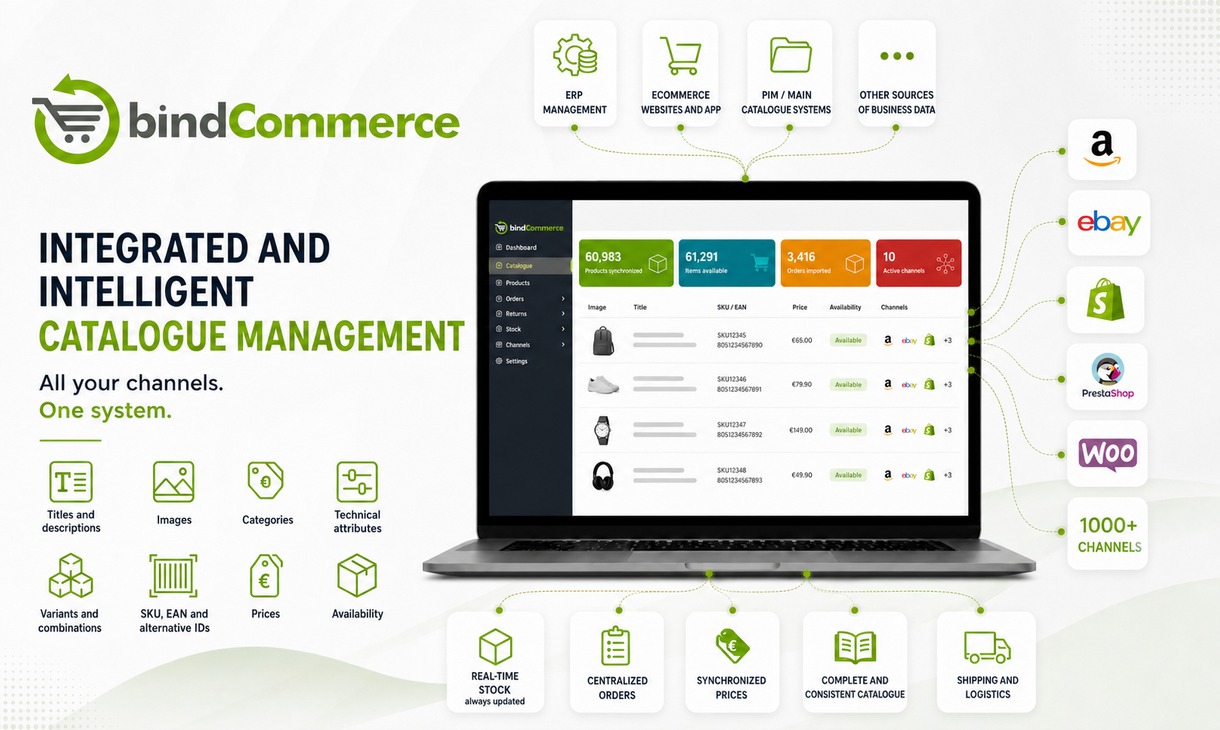
The platform acts as a central level of integration: it acquires data from source systems, applies the rules defined by the company and distributes the information to the connected channels.
In this way each system can continue to carry out its function, whilst preventing products, orders and availability from remaining isolated within separate environments.
What systems can bindCommerce connect
Each project is built based on the company's architecture and processes. The ecosystem can include:

eCommerce platforms

generalist and vertical marketplaces

management and ERP

catalogues and PIM systems

warehouses and logistics systems

tools for shipments and couriers

B2B portals

business applications and services.
The value of integration does not depend only on the number of connections available, but on the depth of the flows managed and the ability to adapt them to the company's operating rules.
Centralize the product catalog
One of the first processes addressed in multi-channel projects is catalog management.

The information can come from the management system, eCommerce or another central source and include:
- titles and descriptions;
- images;
- categories;
- technical attributes;
- variants and combinations;
- SKU codes, EANs and other identifiers;
- prices;
- availability.
bindCommerce allows you to distribute this information to sales channels, adapting it when necessary to the formats and requirements of each platform.
Centralization reduces repetitive changes and allows data to be updated from a main source. The topic is also explored in depth in the guide on how to centralize the catalog to avoid manual errors in multichannel.
Manage different prices for each channel
Selling the same product on multiple platforms does not necessarily mean charging the same price everywhere.
Fees, logistics costs, promotions, currencies and trading strategies may require different rules.
Through centralized management it is possible to apply, for example:
- percentage increases;
- reductions and promotions;
- dedicated price lists;
- fixed prices per channel;
- rounding rules;
- country or marketplaces specific conditions.
The price is modified in the main source and subsequently recalculated for the different channels, avoiding manual interventions on each individual advertisement.
Synchronize stock and availability
When the same product is published on multiple channels, each sale must quickly update the quantity available in the other environments.
bindCommerce can acquire availability from the system chosen as the main source and distribute it to eCommerce and marketplaces.
The rules can take into account:
- physical stock;
- quantities already committed;
- safety stocks;
- different warehouses;
- quantities dedicated to specific channels;
- composite products, kits and variants.
The aim is to reduce the risk of overselling, canceled orders and inconsistent availability. These aspects are explored in depth in the guide on how to synchronize stock between eCommerce and marketplaces.
Acquire orders in a single flow
Another central process concerns orders coming from different channels.
Instead of controlling and managing each dashboard separately, orders can be acquired and transferred to the management system, warehouse or other company systems.
The flow can include:
- automatic acquisition of the order;
- recognition of products and variants;
- normalization of customer data;
- transfer to management system or ERP;
- availability update;
- send to warehouse;
- shipment management;
- return tracking and status to the originating channel.
This helps reduce manual re-entries, forgotten orders and inconsistencies between different systems.
An integration built on company rules
Companies do not all manage catalogues, orders and logistics in the same way.
They may change:
- the system considered the main source;
- the structure of the catalogue;
- the price rules;
- the publication criteria;
- the frequency of updates;
- stock management;
- administrative flows;
- the organization of warehouses;
- shipping and returns procedures.
For this reason bindCommerce is not only used as a technical connector. The configuration must translate the company's commercial and operational rules into automated flows.
Which companies is bindCommerce aimed at
bindCommerce is aimed primarily at companies that have outgrown single-channel management or are planning multi-channel growth.
It can be useful when:
- it is sold through multiple marketplaces;
- the catalog contains numerous products or variants;
- prices and availability change frequently;
- orders are transferred manually;
- the management system does not communicate directly with the channels;
- there are multiple warehouses or companies;
- you want to enter new markets;
- repetitive activities take up too much time;
- errors begin to impact the customer experience.
Integration can be developed progressively, starting from the most critical processes and subsequently adding new channels and automations.
From technology to operational project
Technically connecting two systems is not sufficient if the business flows have not been defined first.
An integration project requires you to establish:
- which system owns each piece of data;
- in which direction the information must travel;
- which transformations must be applied;
- when the update should take place;
- how anomalies should be managed;
- who must receive notifications and intervene.
The initial analysis work is therefore essential to build a stable and coherent integration with the real needs of the company.
How to evaluate a project with bindCommerce
Before starting an integration it is useful to collect some information:
- eCommerce platforms used;
- marketplaces active or to be activated;
- management or ERP;
- number of products and variants;
- approximate volume of orders;
- update frequency;
- number of warehouses;
- currently manual processes;
- major errors or bottlenecks.
These elements allow us to understand which flows must be integrated and with what priority.
Do you want to evaluate your multi-channel project?
Conclusions
Multichannel growth does not just depend on the opening of new marketplaces. It depends on the ability to coordinate the data and processes that connect product, order, warehouse and customer.
bindCommerce was created to create this connection, integrating eCommerce, marketplaces, management and operating systems within centralized flows.
Reducing manual activities allows companies to dedicate more time to commercial decisions and add new channels without proportionally multiplying complexity.