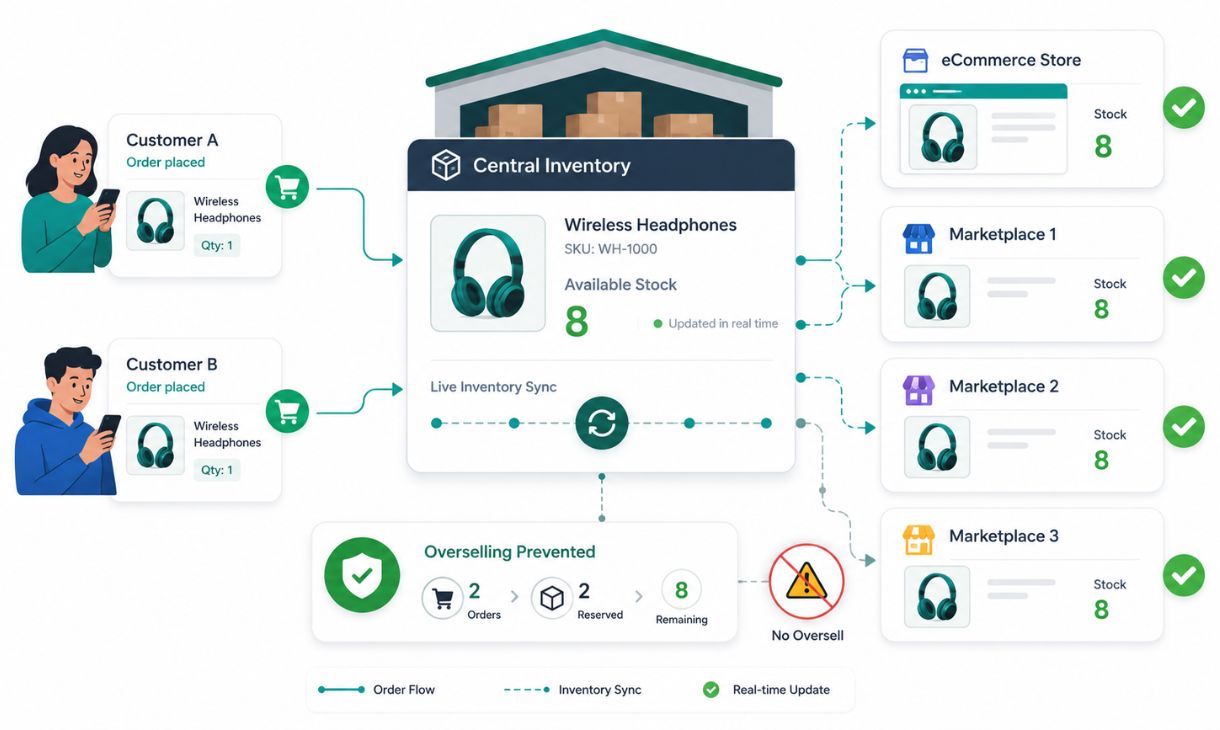
How to synchronize stock between eCommerce and marketplace and avoid overselling
Correctly synchronizing stock between eCommerce site, marketplaces, physical stores and other sales channels is one of the most important aspects of multi-channel management.
When availability is not updated quickly and consistently, the risk is selling products that are no longer actually available. This phenomenon is called overselling and can cause cancellations, delays, complaints and penalties by the marketplaces.
In this guide we see how stock synchronization works, which data must be coordinated, which errors to avoid and which solutions to use to keep quantities updated on all channels.
What does it mean to synchronize stock
Synchronizing stock means keeping the available quantities of the same product aligned in all systems and channels in which it is managed or sold.
These systems may include:
- the management software or ERP;
- the eCommerce site;
- Amazon, eBay and other marketplaces;
- physical stores;
- internal or external warehouses;
- logistics operators and fulfillment centers;
- B2B portals;
- social commerce.
When a sale, reservation, return or inventory adjustment is recorded, the change must be transferred to the other systems involved.
The objective is to show availability on each channel that is consistent with the quantity that can actually be sold.
What is overselling
Overselling occurs when a company sells a greater quantity than actual availability.
A simple example:
- the warehouse has only one piece;
- the product is published simultaneously on the site and on two marketplaces;
- the quantity shown is 1 on each channel;
- two customers buy almost at the same time;
- one of the two orders cannot be fulfilled.
The problem is not necessarily human error. It can also be due to synchronization delays, disconnected systems, infrequently scheduled updates, or unreliable inventory data.
What consequences can overselling cause
Overselling doesn't just produce an order to cancel. It may have broader commercial and operational consequences.
- customer dissatisfaction;
- negative reviews;
- increase in customer service requests;
- refunds and additional administrative tasks;
- loss of trust in the brand;
- deterioration of seller metrics;
- penalties or suspensions on marketplaces;
- time wasted searching for replacement products;
- urgent shipping costs or extraordinary supply.
For a company that sells across multiple channels, even a small percentage of errors can quickly turn into a significant problem.
Why stock is misaligned between eCommerce and marketplaces
The causes can be different and often add to each other.
Manual updates
When quantities are changed separately on each platform, it is easy to forget a channel or enter an incorrect value.
Syncs too slow
An update performed every hour may be insufficient for products with few units available or with a high sales speed.
Non-integrated systems
The management system, the eCommerce site and the marketplaces can use separate databases and not communicate automatically.
Inconsistent SKUs
If the same product is identified with different codes, the system may not be able to correctly associate the sales with the relevant stock.
Incorrectly handled variants
Size, color, format and other variations must have separate availability. An update at the main product level may produce incorrect quantities on individual combinations.
Orders not confirmed or not imported
An order present on the marketplaces but not yet acquired by the central system may temporarily leave an already committed quantity available.
Uncoordinated returns and cancellations
A returned product must not automatically become available again if it has not been checked and reinstated in salable stock.
More warehouses
If inventory is distributed across different locations, the system needs to know what quantity can be used for each channel, country, or shipping method.
Physical, available and salable stock: they are not the same thing
One of the most frequent mistakes consists in publishing on the channels the entire quantity physically present in stock.
It is useful to distinguish between:
- physical stock: quantity physically present;
- committed stock: quantity already associated with orders not yet shipped;
- reserved stock: quantity blocked for stores, customers, promotions or other uses;
- damaged or unsellable stock: goods present but not available for sale;
- available stock: residual quantity after subtracting commitments and reserves;
- publishable stock: quantity that the company actually decides to show on the channels.
The published quantity should therefore derive from a rule, not from simply reading the physical number present in the warehouse.
How centralized synchronization works
In centralized management, a main source for availability is defined.
This source can be:
- the ERP;
- the warehouse management system;
- a WMS;
- a WHO;
- a multi-channel integration platform.
The typical flow involves:
- the central system calculates the available quantity;
- availability is sent to sales channels;
- orders are acquired automatically;
- the quantity is reserved or decreased;
- the new stock is redistributed to the other channels;
- cancellations and returns update availability again.
In this way the site and the marketplaces do not manage independent quantities, but receive values calculated according to common rules.
Which system should be the primary source of stock
The main source must be the system that has the most complete and reliable data.
In many companies it is the management system or ERP, because it records purchases, sales, movements and adjustments. In more complex logistics structures, the WMS may instead know the actual availability of the warehouse in real time.
The choice depends on:
- number of warehouses;
- frequency of movements;
- management of batches and serials;
- presence of physical shops;
- booking processes;
- management of returns and non-compliant products;
- reliability of existing integrations.
It is important to avoid multiple systems being considered the definitive source of the same data at the same time.
Real-time or scheduled synchronization
Not all integrations update availability with the same frequency.
Real-time synchronization
The update starts immediately after a sale or change.
It is particularly useful for:
- products with low stock;
- highly rotating articles;
- promotions and campaigns;
- sales on many channels;
- peak periods;
- unique products or products that cannot be easily reordered.
Scheduled synchronization
The system updates the quantities at pre-established intervals, for example every 5, 15 or 60 minutes.
It may be sufficient when:
- the stock is high;
- the number of orders is limited;
- products have a slow rotation;
- channels do not support immediate updates;
- the system applies a safety stock.
The frequency must be chosen based on the real risk, not just the technical ease of integration.
How to use a safety stock
One of the simplest strategies to reduce overselling is to not publish the entire available quantity.
If the system detects 10 units, the company can decide to show only 8, maintaining a safety stock of 2 pieces.
The rule can be:
- a fixed quantity;
- a percentage of the stock;
- different by product or category;
- different for marketplaces;
- applied only below a certain threshold.
Safety stock is useful, but it is not a substitute for reliable synchronization. Reduces risk, without eliminating the cause of the misalignment.
How to distribute stock across multiple channels
A company can choose between two main models.
Shared stock
All channels sell from the same central availability.
This model allows you to better exploit the overall inventory, but requires rapid and reliable updates.
Dedicated stock per channel
A part of the availability is reserved for each channel.
For example:
- 50 units for the site;
- 30 for Amazon;
- 10 for a vertical marketplaces;
- 10 for the physical store.
This model reduces the risk of conflict, but can leave merchandise unsold on one channel while another uses up its quota.
It is also possible to use a hybrid model, with a shared part and a reserved part.
How to manage stock with multiple warehouses
When the company has multiple warehouses, availability cannot be considered as a single number without further rules.
The system must evaluate:
- geographical location of the customer;
- country of sale;
- shipping costs;
- delivery times;
- order origin channel;
- type of product;
- priority assigned to warehouses;
- operational capacity of the offices.
A product may be physically available, but not usable for a specific order because it is located in a warehouse that does not serve that country or channel.
How to manage kits, bundles and composite products
The kits represent a particular criticality.
If a bundle contains three products, its availability depends on the component with the lowest quantity.
For example, a kit contains:
- 2 units of product A;
- 1 unit of product B;
- 1 unit of product C.
If 10 pieces of A, 3 of B and 8 of C are available, the system can sell a maximum of 3 kits.
When a kit is sold, the quantities of the individual components and any other bundles that use them must also be updated.
How to manage returns, cancellations and unpaid orders
Availability does not only depend on completed sales.
The system must determine when a quantity is:
- reserved;
- decremented;
- freed;
- reinstated;
- excluded from sale.
An unpaid order may temporarily reserve stock, but after a certain period the quantity should be available again.
A canceled order can release the goods immediately, while a return should only be reinstated after physical verification of the product.
What checks to perform on synchronizations
An automatic synchronization should not be considered foolproof. It is necessary to monitor it.
The main controls concern:
- date and time of the last update;
- number of products processed;
- products excluded or with error;
- Unrecognized SKUs;
- unassociated variants;
- execution times;
- orders not imported;
- unreachable channels;
- anomalous differences between central stock and published quantity.
Errors should generate clear notifications and allow the team to intervene before they produce unfulfillable orders.
The most common mistakes in multi-channel inventory management
- use different SKU codes for the same product;
- update stock manually on each platform;
- do not subtract the quantities already committed;
- release all inventory without a safety stock;
- ignore returns and cancellations;
- do not monitor synchronizations;
- handle variants incorrectly;
- do not upgrade the kit components;
- consider the stock present in unusable warehouses salable;
- add new channels without checking system capacity.
Many of these problems arise from separate data management. For further information you can also read how to avoid manual errors in multi-channel management.
When you need an integration platform
An integration platform becomes particularly useful when:
- the company sells on multiple marketplaces;
- quantities change frequently;
- there are many products or variations;
- orders must automatically update the management system;
- there are multiple warehouses;
- kits or bundles are used;
- manual synchronizations take too long;
- errors begin to compromise the service.
The central system can acquire the stock from the main source, apply commercial rules and distribute the correct quantities to the different channels.
This process is part of a broader multichannel sales management strategy, which also includes catalogue, prices, orders, integrations and logistics.
How to start syncing stock correctly
A practical path may include these steps:
- identify the main source of availability;
- uniform SKUs across all systems;
- map products and variants on the different channels;
- define the truly salable stock;
- establish the update frequency;
- apply any safety stocks;
- automate order acquisition;
- manage returns and cancellations;
- monitor errors and synchronization times;
- test the flow before extending it to the entire catalog.
It is advisable to start with a limited number of products and simulate simultaneous sales, cancellations, returns and manual inventory changes.
Insights on multi-channel management
- Multichannel sales: what it is, how it works and how to manage it
- Multichannel and omnichannel sales: differences, advantages and examples
- How to avoid manual errors in multichannel management
- eCommerce logistics management: complete guide 2026
Conclusions
Stock synchronization is one of the central processes of multi-channel sales.
It's not enough to update a quantity after each order. It is necessary to distinguish physical, committed, reserved and truly salable stock, coordinating orders, returns, variants, kits and multiple warehouses.
A reliable data source, automatic integrations, adequate frequencies and constant checks allow us to reduce overselling and keep availability consistent across all channels.
In this way the company can expand its commercial presence without uncontrollably increasing cancellations, errors and manual activities.