Multi-channel sales: what it is, how it works and how to manage it
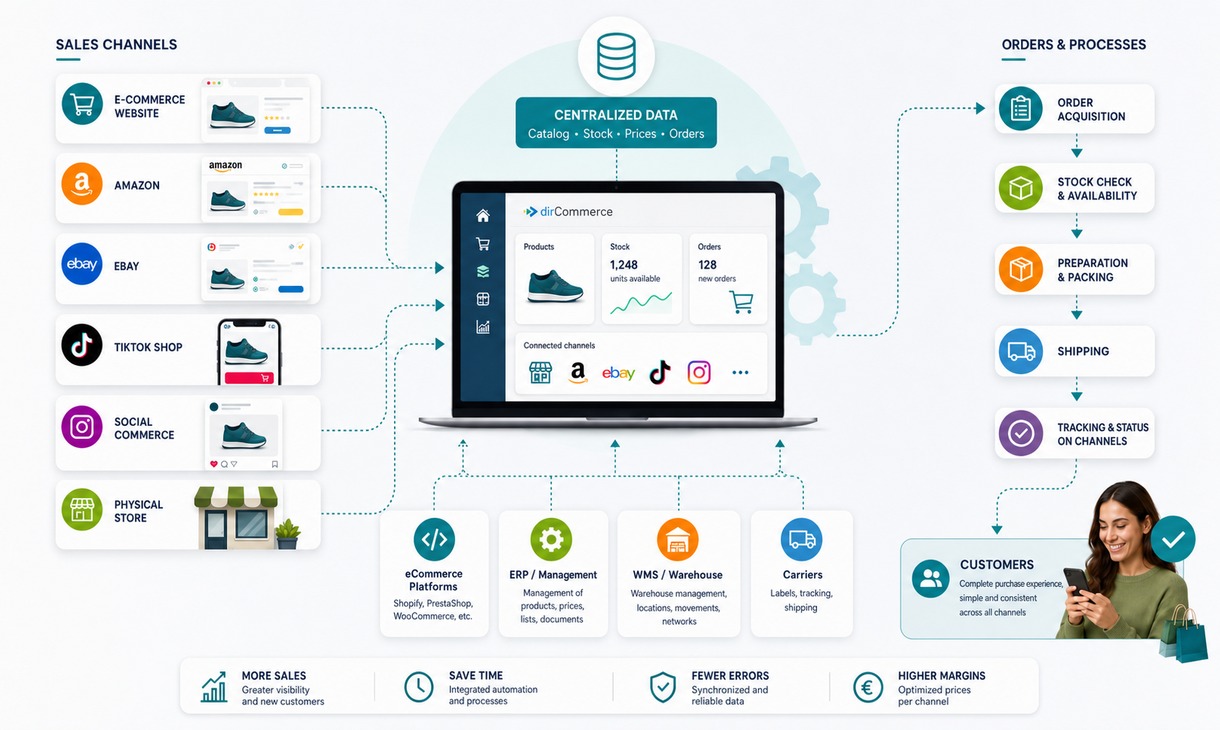
Selling through multiple channels allows a company to reach different audiences, increase product visibility and reduce dependence on a single platform. An eCommerce can combine its site with one or more marketplaces, physical stores, social commerce, B2B portals and other digital channels.
The growth of channels, however, brings with it greater operational complexity. Each environment may have different rules, fees, formats, prices and order flows. Without central coordination, the risk of catalog errors, outdated availability, duplicate orders, overselling and shipping delays increases.
Multi-channel selling therefore does not just consist of publishing the same products on multiple platforms. It requires a strategy capable of coordinating information, processes and business systems.
What is multi-channel sales
Multi-channel sales is a commercial strategy through which a company offers its products or services on two or more sales channels.
The channels can be owned by the company, such as the eCommerce site or the physical store, or belong to external parties, such as marketplaces and social commerce platforms.
A company could, for example, simultaneously sell through:
- your own eCommerce site;
- Amazon;
- eBay;
- vertical marketplaces dedicated to a specific product category;
- social network with sales functionality;
- physical stores;
- B2B portals or reseller networks.
The objective is to intercept the customer in the channel he prefers to use. Each channel, however, must be included within a coordinated process, avoiding transforming commercial growth into a multiplication of manual activities.
What are the main sales channels
There is no one-size-fits-all combination. The choice depends on the product, the audience, the margins, the geographic markets and the organizational capacity of the company.
Owner eCommerce site
The proprietary site offers greater control over the shopping experience, content, customer data and promotional strategies. However, it requires autonomous marketing activities, traffic acquisition, technological management and conversion optimization.
Generalist marketplaces
Platforms such as Amazon and eBay allow access to an audience already accustomed to purchasing online. In exchange, the merchant must comply with operational rules, service levels, commissions and channel-specific requirements.
When volumes grow, it becomes important to automate the management of sales and orders coming from Amazon, avoiding manually transferring data between marketplaces, management and warehouse.
Vertical marketplaces
Vertical marketplaces focus on specific industries, such as fashion, furniture, electronics, sports, books, or professional products. They can offer a more qualified audience, but often require catalogs structured according to their own attributes, categories and formats.
Social commerce
Social networks are also becoming environments for discovery and purchase. The product is presented through content, creators, live broadcasts and personalized recommendations. In this context, catalogue, availability and orders must be synchronized with other company channels.
Physical stores and B2B channels
The multi-channel strategy can also include points of sale, agents, resellers, wholesalers and portals reserved for professional customers. In these cases it is even more important to distinguish prices, price lists, commercial conditions and availability for each channel.
Multi-channel and omni-channel sales: what are the differences
Multichannel and omnichannel are often used synonymously, but they describe two different levels of integration.
In multi-channel sales the company is present on multiple channels. However, each channel can maintain partially independent processes, data and experiences.
In the omnichannel approach, however, the different contact points are coordinated to offer the customer a continuous experience. The customer can start a journey on one channel and continue it on another without perceiving interruptions.
For example, it could:
- consult a product on the site;
- check availability in store;
- purchase it via a marketplaces;
- request assistance through another channel;
- make a return in a physical store.
Multi-channel therefore concerns presence on multiple channels; omnichannel concerns above all their integration. To learn more about this evolution you can read the guide on the omnichannel strategy and the integration between online sales and marketplaces.
For a more detailed comparison, with practical examples, advantages and limitations of the two models, consult our in-depth study on differences between multichannel and omnichannel sales.
How to manage catalog and product information
The catalog is one of the most complex elements of multi-channel sales. Titles, descriptions, images, categories, attributes and variants may need to be adapted to the characteristics of each platform.
The same product can request:
- titles of different lengths;
- different categories;
- specific mandatory attributes;
- images with particular formats;
- translated descriptions;
- identification codes or technical data sheets;
- different rules for variations and combinations.
Handling this information separately in each channel increases the risk of inconsistencies and slows down updates.
A centralized catalog instead allows you to start from a main source and distribute the data to the different channels, applying transformation and adaptation rules when necessary. This approach reduces repetitive changes and makes it easier to keep information up to date.
A centralized structure also helps to avoid manual errors in multi-channel management, especially when the same product is updated frequently.
How to synchronize stock and availability
Availability must be updated quickly across all channels. If a product is sold on a marketplaces, the quantity available on the site and on other channels must be recalculated without excessive delays.
Otherwise the following may occur:
- sales of products no longer available;
- orders cancelled;
- delays in deliveries;
- penalties by marketplaces;
- negative experiences for customers;
- unreliable warehouse data.
Stock synchronization must take into account not only sales, but also returns, cancellations, incoming goods, reserved stocks and availability distributed across multiple warehouses.
In some cases it is useful to publish a smaller quantity on the channels than the actual stock, maintaining a safety stock. This rule can reduce the risk of overselling when updates do not occur in real time or when multiple orders are received at the same time.
To learn more about rules, update frequencies, safety stocks and availability management, consult the guide on how to synchronize stock between eCommerce and marketplaces and avoid overselling .
How to manage different prices for each channel
Applying the same price on all channels is not always the most convenient choice. Each platform may have different costs and features.
The price may vary depending on:
- marketplaces fees;
- logistic costs;
- promotional costs;
- country of sale;
- evaluate;
- competition present in the channel;
- desired margin;
- specific commercial strategies.
A product sold for 80 euros on the site could therefore be published at a higher price on a marketplaces that applies higher commissions. Likewise, a promotion on the proprietary site does not necessarily have to be replicated on all channels.
Centralized management allows you to apply rules such as percentage increases, fixed prices, rounding, dedicated price lists and temporary discounts without manually intervening on each advert.
How to centralize orders
When orders come in from multiple channels, the operations team shouldn't have to continually check different dashboards.
Orders must flow into a central system that allows:
- view all sales in one environment;
- verify payments and customer data;
- check availability and stock;
- transmit orders to the management system;
- start preparation and shipping;
- update the status on the source channel;
- manage cancellations, returns and refunds.
Centralization reduces the risk of an order being forgotten or entered twice. It also allows you to apply uniform processes regardless of the channel from which the sale comes.
An OMS, i. E. An Order Management System, can coordinate these flows and maintain an overall view of the order status.
How to integrate ERP, eCommerce and marketplaces
The ERP or company management system should remain one of the main sources of administrative, commercial and warehouse data. The eCommerce site and the marketplaces instead represent the channels through which the products are published and sold.
To avoid manual tasks, these systems must communicate through reliable, bidirectional integrations.
A typical flow may include:
- products, prices and availability start from the management system or from a central system;
- the data is adapted and distributed to sales channels;
- orders are acquired automatically;
- sales update the stock;
- the data is transferred to the warehouse and logistics systems;
- tracking and order status return to the original channel.
The choice of CMS is important, but must be evaluated together with the ability to connect it to other systems. In fact, in many projects, the integration between Shopify, PrestaShop, WooCommerce and company systems is more important than the platform used.
How to manage logistics and shipping
The increase in channels also produces an increase in logistics flows. Orders may have different delivery methods, couriers, times and requirements.
Coordinated management should allow you to:
- transmit orders to the correct warehouse;
- organize picking and packing;
- select the most suitable shipping service;
- automatically generate labels;
- communicate the tracking to the customer and the marketplaces;
- monitor delays and exceptions;
- manage returns and stock returns.
Logistics rules may change by country, weight, size, order value, product type and level of service required.
To better understand the entire process you can consult our complete guide to the management of eCommerce logistics, which delves into orders, warehouse, OMS, WMS, TMS, couriers and fulfillment.
The most frequent errors in multi-channel management
Many problems do not depend on the single marketplaces, but on the lack of coordination between systems.
Among the most common errors we find:
- manually update prices and quantities on each channel;
- use different files without a main data source;
- publish products without verifying mandatory requirements and attributes;
- do not check for synchronization errors;
- apply the same price without considering costs and commissions;
- acquire orders manually;
- do not promptly update tracking and shipment status;
- adding new channels without evaluating the operational impact;
- do not define responsibilities and procedures for managing anomalies.
Risk increases when each channel is managed as an independent project. A sustainable strategy must instead include common processes and central rules.
When you need an integration platform
With just a few products and just one additional channel, some tasks can initially be handled manually. This solution, however, quickly becomes difficult to sustain as the catalog, orders and frequency of updates increase.
An integration platform becomes particularly useful when:
- the company sells on multiple marketplaces;
- the catalog contains many variations;
- prices and stocks change frequently;
- orders must be transferred to ERP or warehouse;
- there are multiple price lists or sales countries;
- manual errors are starting to impact service;
- the team spends too much time on repetitive activities;
- the company wants to add new channels without multiplying the work.
The platform does not replace the commercial strategy. Its task is to make the rules defined by the company applicable and automate the exchange of data between the different systems.
How to start a multi-channel strategy
The best choice is not necessarily to open as many channels as possible. It is preferable to start with those most consistent with the product and the public, checking that the organization is able to manage them correctly.
A gradual path can include:
- analyze customers and identify the channels they use most;
- evaluate costs and margins of each platform;
- define a main source for catalogue, prices and availability;
- map the flows from the product to shipping and return;
- establish commercial rules for prices, assortments and promotions;
- automate repetitive exchanges between systems;
- Monitor errors and performance before adding more channels.
It's helpful to start with a pilot project, using a portion of your catalog or a single marketplaces. In this way it is possible to verify product classification, inventory updates, order acquisition and shipment management before extending the process.
Insights on multi-channel sales
- How to avoid manual errors in multichannel management
- Omnichannel strategy: how to integrate online sales and marketplaces
- Shopify, PrestaShop or WooCommerce? Why integration is more important than the platform
- eCommerce logistics management: complete guide 2026
Conclusions
Multi-channel sales offers important growth opportunities, but requires a more structured organization than managing a single online store.
The point is not just to be present on multiple platforms. Catalogue, stock, prices, orders, management, warehouse and shipping must work as parts of a single process.
An effective strategy starts from choosing the most suitable channels, defines clear commercial rules and uses integration to reduce manual activities. In this way the company can expand its commercial presence without losing control of data, margins and quality of service.