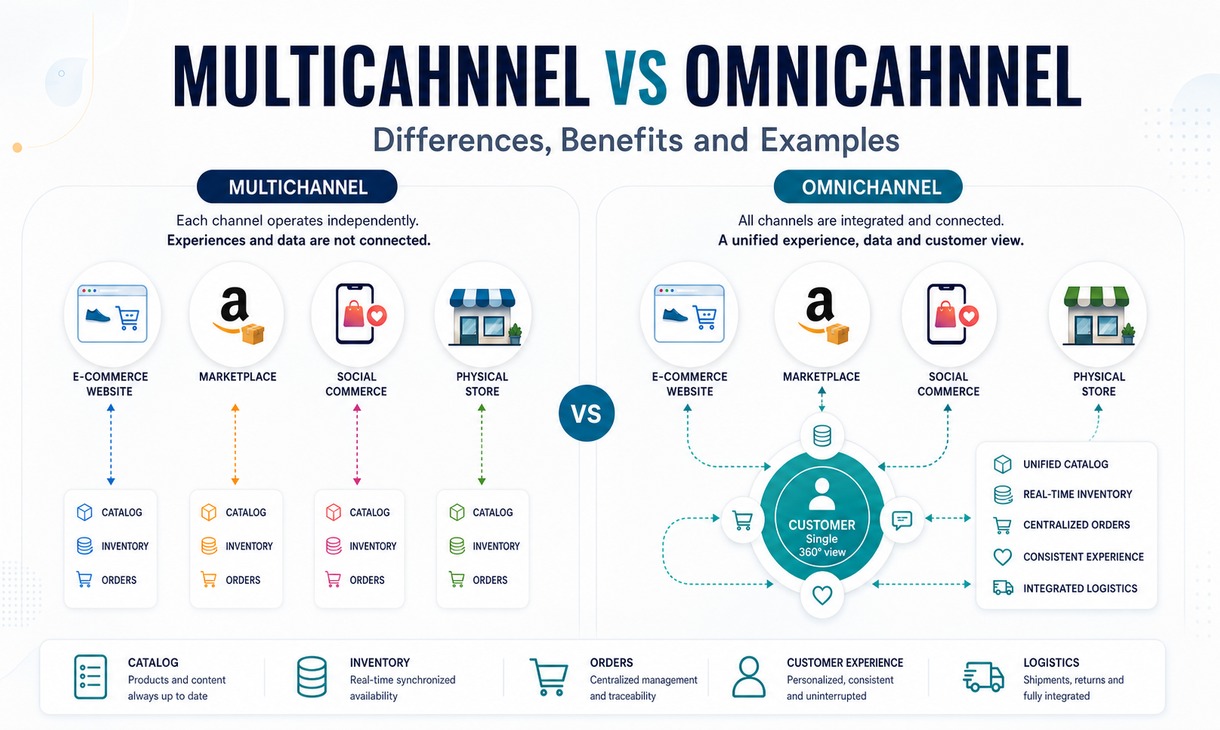
Multichannel and omnichannel sales: differences, advantages and examples
Multi-channel and omni-channel sales are often considered the same thing, but they indicate two different models of managing sales channels and customer relationships.
Both approaches involve the presence of the company on multiple contact points, such as eCommerce site, marketplaces, physical stores, social commerce, apps, B2B portals and customer service. The main difference concerns the level of integration between these channels.
In multi-channel selling, channels can function relatively independently. In omnichannel, however, data, processes and customer experience are coordinated to create a continuous journey.
In this guide we see what multichannel and omnichannel mean, what the operational differences are, the main advantages and some practical examples.
What is multi-channel sales
Multi-channel selling is a strategy through which a company sells products or services using multiple channels.
A merchant can, for example, sell simultaneously via:
- your own eCommerce site;
- Amazon;
- eBay;
- vertical marketplaces;
- social networks;
- physical stores;
- B2B portals;
- reseller networks.
Each channel allows you to reach a different audience and can have its own rules, commissions, catalog formats, payment methods and operational flows.
In the multi-channel model, however, the different environments can remain partially separated. The eCommerce site can use a catalogue, the marketplaces a different update flow and the physical store a different management system.
Presence on multiple channels therefore does not automatically guarantee that they are integrated with each other.
To learn more about the organization of catalogues, prices, stocks, orders and logistics you can consult our complete guide to multichannel sales.
What is omnichannel sales
Omnichannel sales represents an evolution of the multichannel model.
The company continues to use multiple channels, but coordinates them in order to offer the customer a consistent and continuous experience.
The customer no longer perceives the site, app, marketplaces, store and customer service as completely separate environments. You can start your journey on one channel and continue it on another without losing information or having to start over.
In an omnichannel strategy, for example, the customer can:
- view a product online;
- check availability in a store;
- book it via the app;
- physically withdraw it;
- request assistance via WhatsApp or telephone;
- make the return through a different channel than the purchase one.
To make this continuity possible it is necessary to integrate data, catalogues, orders, inventory, customers, payments and logistics.
What is the difference between multi-channel and omni-channel
The fundamental difference is not the number of channels used, but the way in which they communicate with each other.
| Element | Multichannel | Omnichannel |
|---|---|---|
| Main objective | Be present on multiple channels | Create a seamless experience across channels |
| Channel management | Often separated | Coordinated and integrated |
| Customer data | Can be deployed in different systems | Shared and consultable between the different touchpoints |
| Catalogue and stock | May have independent updates | Align yourself between channels and points of sale |
| Customer experience | Different for each channel | Coherent and continuous |
| Technological complexity | More contained in the initial stages | Major, because it requires deep integrations |
Multi-channel sales above all respond to the question:
Which channels do we want to sell on?
The omnichannel instead answers the question:
How can we connect these channels to offer a single customer experience?
A practical example of multi-channel sales
Let's imagine a company that sells sporting goods through:
- your own eCommerce site;
- Amazon;
- a specialized marketplaces;
- a physical store.
In the multi-channel model, each environment can have:
- different promotions;
- partially different catalogues;
- stocks updated with different frequencies;
- specific procedures for returns and assistance;
- orders managed via separate dashboards.
The company is present on multiple channels and can reach different customers, but each channel continues to function as a relatively autonomous unit.
A practical example of omnichannel sales
Let's consider the same company in an omnichannel model.
A customer views a pair of shoes on the site, checks availability in the nearest store and books the product. After trying it in store, complete the purchase via the company app using a coupon received via email.
After purchase, the order history is also available from customer service. If the customer requests assistance, the operator can see:
- the product consulted;
- the reservation made;
- the selected store;
- the completed order;
- payment;
- any previous requests.
In this case the different channels participate in a single path, sharing data and information.
The advantages of multi-channel sales
Multi-channel sales often represent the first step in expanding your commercial presence.
Greater visibility
Being present on multiple platforms allows you to reach users who do not yet know the owner site.
Access to different audiences
Each marketplaces or channel can have its own customer base, interests and purchasing habits.
Reduced dependency on a single channel
Distributing sales across multiple platforms reduces the risk of being completely dependent on the traffic, rules or algorithms of a single operator.
Possibility to test new markets
A marketplaces can be used to gauge demand in a new country or sector before making larger investments.
Greater commercial flexibility
The company can differentiate assortment, prices, promotions and strategies based on the characteristics of each channel.
The limits of multi-channel sales
The main limitation emerges when each channel is managed separately.
One of the main risks is showing outdated availability on different channels. To learn more about this problem, read the guide on how to synchronize stock between eCommerce and marketplaces and avoid overselling .
With the increase in channels they can multiply:
- manual updates;
- dashboard to check;
- catalog file;
- price rules;
- orders to transfer;
- synchronization errors;
- different operating procedures.
If catalogue, inventory and orders are not centralized, commercial growth can produce even greater growth in complexity.
This is why it is important to reduce manual errors in multi-channel management through integrated flows and reliable data sources.
The advantages of the omnichannel strategy
Smoother customer experience
The customer can move from one channel to another without interruptions and without having to repeat information already provided.
Unified customer view
Data from site, store, app, customer service and other touchpoints can be brought together into a more complete profile.
Greater customization
By knowing previous purchases, preferences and interactions, the company can propose more relevant communications and offers.
Coordination between online and offline
The omnichannel allows you to integrate physical stores and eCommerce through services such as:
- click and collect;
- online booking;
- returned in store;
- shipping from the point of sale;
- consultation of local stock;
- orders assisted by staff.
Better operational management
System integration allows you to obtain a more complete view of orders, availability, customers and logistics processes.
The limits and difficulties of omnichannel
The omnichannel model offers greater possibilities, but also requires a more advanced technological and organizational structure.
The main difficulties concern:
- integration between different systems;
- data quality and consistency;
- stock synchronization;
- unique identification of the customer;
- coordination between departments;
- management of payments, returns and cross-channel promotions;
- staff training;
- definition of common processes.
Omnichannel cannot be achieved simply by adding a new channel. We need to rethink how systems and departments share information.
What systems are needed for an omnichannel strategy
The structure depends on the size and business model of the company, but can include:
- ERP or management software;
- eCommerce platform;
- CRM;
- PIM for product information;
- OMS for order management;
- WMS for the warehouse;
- multi-channel integration software;
- customer service systems;
- payment and loyalty tools;
- marketing automation platforms.
These systems must communicate through reliable integrations. The eCommerce platform cannot be considered an isolated environment, but must communicate with the rest of the company architecture.
This is why, in many projects, the integration between Shopify, PrestaShop, WooCommerce and business systems is more important than just the choice of platform.
How to move from multichannel to omnichannel
Not all companies need to immediately transition to a full omnichannel model.
It is possible to proceed gradually, starting from the most important processes.
1. Map existing channels
The first step is to list all the touchpoints used by customers and operators:
- site;
- marketplaces;
- shops;
- social;
- telephone;
- email;
- app;
- B2B portals.
2. Identify key data
You need to determine which system it manages:
- product master data;
- prices;
- stock;
- customers;
- orders;
- shipments;
- returns;
- payments.
3. Define a reliable source for each data
Every information must have a main source. Otherwise, different systems may return inconsistent values.
4. Integrate critical processes first
It is often useful to start with:
- stock synchronization;
- centralization of orders;
- customer data alignment;
- returns management;
- tracking sharing.
5. Measure the experience across channels
It's not enough to verify that systems exchange data. It is also necessary to check whether the customer can actually move from one channel to another without obstacles.
Multichannel or omnichannel: which one to choose
Multi-channel sales is suitable for companies that want to expand their presence and reach new audiences without immediately achieving complete integration of all touchpoints.
Omnichannel is more suitable when the customer frequently uses different channels during the same journey and when the company needs to coordinate online, offline, assistance, orders and services.
The choice depends on:
- number of channels;
- catalog size;
- presence of physical shops;
- frequency of purchases;
- complexity of returns;
- customer expectations;
- technological infrastructure;
- available resources.
In many cases the correct path is progressive: first you build an orderly multi-channel management, then you gradually integrate the most important touchpoints until you reach an omni-channel experience.
Insights on multi-channel and omni-channel
- Multi-channel sales: what it is, how it works and how to manage it
- Omnichannel strategy: how to integrate online sales and marketplaces
- How to avoid manual errors in multichannel management
- eCommerce logistics management: complete guide 2026
Conclusions
Multichannel and omnichannel do not indicate two completely opposite strategies. Rather, they represent two different levels of maturity in channel management.
In the multi-channel model the company uses multiple platforms to sell and communicate. In the omnichannel model these environments are connected to offer the customer a continuous and coherent experience.
The priority should not be to add as many channels as possible, but to build reliable processes. Catalogue, stock, orders, customers, support and logistics must be organized before increasing complexity.
A well-managed multichannel strategy therefore represents the basis on which to gradually develop a true omnichannel approach.